


INTRODUCTION
Chronic obstructive pulmonary disease (COPD) is a leading cause of morbidity and mortality worldwide, accounting for >3 million deaths annually and ranking as the third leading cause of death globally1,2. Beyond its impact on survival, COPD substantially reduces quality of life, particularly among individuals of productive age, due to chronic breathlessness, physical limitations, and increased risk of psychological distress such as depression and anxiety3. These consequences diminish individual well‑being and contribute to reduced economic productivity and increased healthcare costs4. The etiology of COPD is multifactorial, involving genetic predisposition, age, sex, tobacco smoke exposure, occupational hazards, socioeconomic status, and a history of respiratory infections, notably tuberculosis (TB)1,5. While smoking is the most recognized risk factor, emerging evidence highlights the significant role of prior pulmonary TB in predisposing individuals to chronic airflow limitation and COPD6. TB can cause irreversible structural damage to the lungs, including airway remodeling, fibrosis, and destruction of lung parenchyma, which may persist even after microbiological cure, thereby increasing the long‑term likelihood of having COPD1,7.
Indonesia faces a dual burden of TB and COPD. According to the World Health Organization, Indonesia ranks second globally in TB incidence, accounting for nearly 9.2% of the world’s cases, with an estimated 969000 new TB cases and 93000 TB‑related deaths in 20228,9. In parallel, COPD prevalence is rising, driven by high rates of smoking, environmental pollution, and the sequelae of infectious diseases. Jember Regency, located in East Java Province, exemplifies this public health challenge10. As the third highest contributor to TB cases in Indonesia11, Jember also reports one of the highest burdens of COPD at the district level. Local health records indicate a persistent overlap of TB and COPD cases, with a substantial proportion of TB patients progressing to chronic respiratory impairment post‑treatment. A preliminary assessment at Jember Lung Hospital highlighted this overlap, with comparable numbers of outpatient COPD and pulmonary TB cases in a single month. Public health records further reveal an elevated incidence of both conditions, exacerbated by limited healthcare resources and low awareness of the long‑term respiratory consequences of TB12.
However, most available information from this setting comes from aggregate public health reports, and little is known about how TB and COPD co‑occur at the level of individual patients within routine respiratory clinics. Leveraging clinic‑based medical records offers a pragmatic way to explore TB–COPD overlap and related factors in a resource‑limited environment13,14. While population‑based cohort studies, largely from high‑income or registry‑rich settings, have demonstrated that TB survivors are more likely to have COPD than individuals without TB15,16, routine clinical data from high‑burden districts in low‑ and middle‑income countries remain scarce. Clinic‑based analyses can complement population‑based cohorts by describing how TB–COPD overlap appears in real‑world service settings and identifying which patient groups are most affected.
International studies have established the link between TB and COPD, but local data are needed to inform context‑specific interventions. The need for such evidence is underscored by the high prevalence of both diseases in Jember, constrained healthcare resources, and the potential for targeted prevention and rehabilitation programs to reduce their dual burden. Therefore, this study aims to assess the association between documented post‑tuberculosis status and current chronic obstructive pulmonary disease among patients attending respiratory clinics in Jember Regency, Indonesia, a district with a high burden of both TB and COPD. By focusing on routinely collected clinic data, this study provides context‑specific evidence on TB–COPD overlap and identifies demographic and environmental factors associated with COPD in this high‑risk setting.
METHODS
Study design
This was a multicenter, clinic‑based, cross‑sectional study conducted in Jember Regency, East Java, Indonesia (STROBE checklist given in the Supplementary file). We used routinely collected outpatient medical records from three respiratory clinics: the Asthma and COPD Clinic and the Infection (TB) Clinic at Jember Pulmonary Hospital, and the Pulmonary Clinic at Jember Klinik Hospital. All eligible visits between 1 January and 31 December 2022 were included. These hospitals were selected because they are major referral centers for respiratory diseases in the district.
Setting and participants
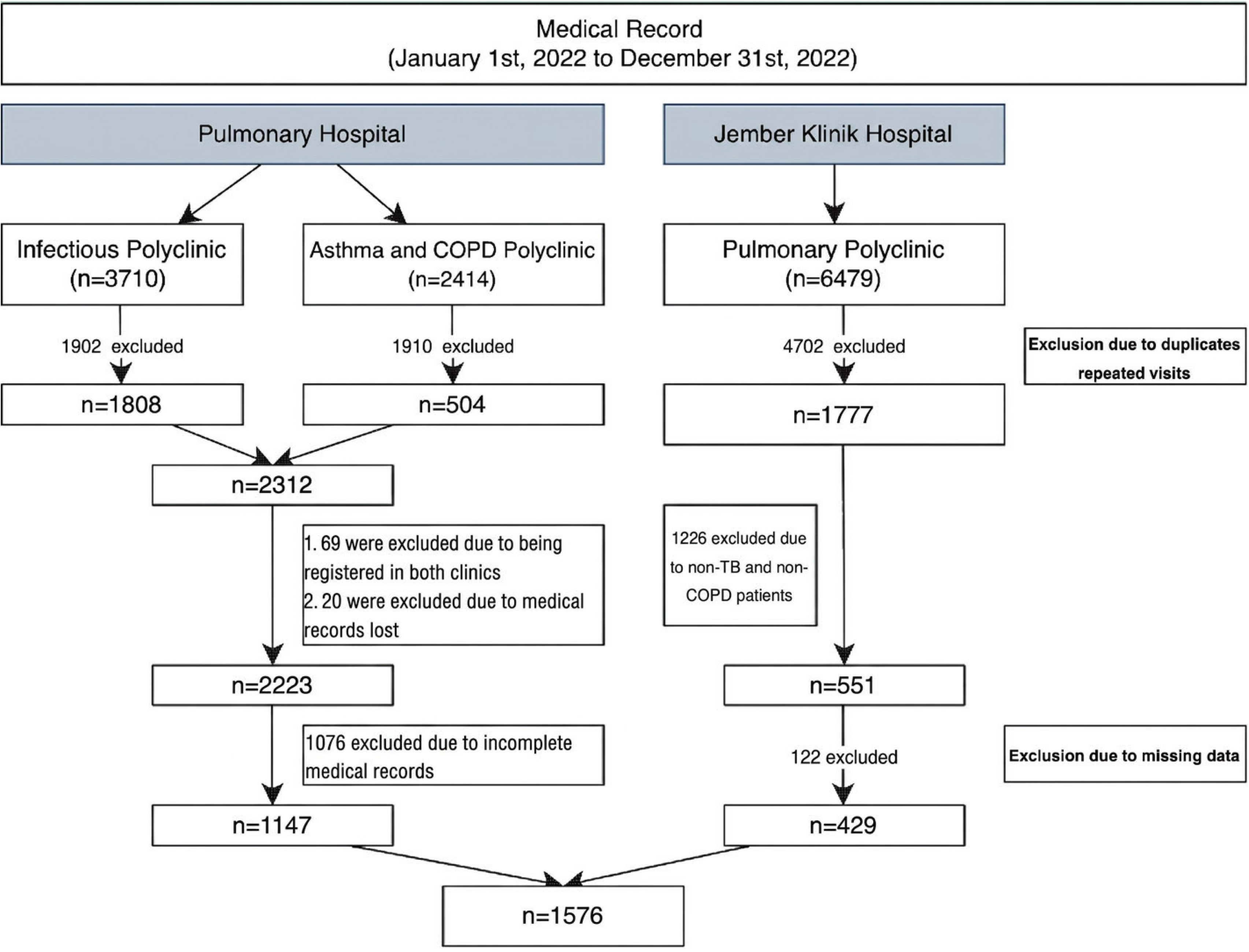
This study was conducted in Jember Regency from January to July 2024. The population in this study comprised all outpatients at the Asthma and COPD Clinic at Jember Pulmonary Hospital, and all outpatients at the Pulmonary Clinic at Jember Klinik Hospital, during the period January to December 2022, for a total of 1730 patients. We included adult outpatients (aged ≥18 years) with available information on COPD diagnosis, documented history of pulmonary tuberculosis, age, sex, occupation, place of residence, education level, and smoking status. Patients with missing data on COPD status or TB history were excluded. For descriptive purposes, patients were categorized according to their clinic of attendance (Asthma & COPD Clinic or Pulmonary Clinic).
Inclusion and exclusion criteria
We included adult outpatients aged ≥18 years with documented COPD status, history of pulmonary TB, age, sex, place of residence, occupation, education level, and smoking status recorded in the medical records. We excluded patients with missing data on COPD diagnosis or TB history, and those with duplicate entries across clinics.
Variables
The primary exposure was a documented history of pulmonary tuberculosis (defined as any documented physician‑diagnosed pulmonary TB with corresponding ICD‑10 codes in the medical records). The primary outcome was COPD status based on the treating physician’s diagnosis as recorded in the clinic charts. Covariates included age (categorized as ≤45 and >45 years based on the distribution of COPD cases and previous literature), sex, place of residence (rural, urban) (based on administrative boundaries), education level (basic for no formal schooling or primary education only, and higher for at least junior high school), smoking status (ever, never) (ever smoker for current or former smoker, and never smoker), clinic type, and occupation (at‑risk vs not at‑risk) (at‑risk occupations as jobs with regular exposure to dust, fumes, or smoke from traditional stoves, e.g. farmers, construction workers, factory workers, and workers exposed to smoke from traditional stoves, based on occupational histories recorded in the medical records). Based on prior evidence, we treated age, sex, residence, occupational exposure, education level, and smoking status as potential confounders and included them in multivariable models.
Data collection and management
Trained research staff extracted data from paper and electronic medical records using a standardized data collection form. Extracted variables included demographic, clinical, and occupational information obtained from routinely collected outpatient medical records; smoking status and occupational history were based on patient self-report as documented by treating physicians. Data were entered into a spreadsheet, checked for completeness and internal consistency, and cleaned by removing duplicates and handling missing values in accordance with predefined rules. Where necessary, information was cross‑checked against original patient charts to verify accuracy. We cleaned the data by removing duplicates and handling missing values. We validated the data by cross‑checking with other sources (patient charts). Study population, exclusions, and missing data are outlined in Figure 1.
Ethical considerations
The study was approved by the Ethical Committee of Medical Research Faculty of Dentistry, Universitas Jember, Indonesia (ethics certificate number No.1843/UN25.8/KEPK/DL/2023). Before data collection, the study objectives and procedures were presented to the hospital management, and approval was obtained to use routinely collected outpatient medical records for research under strict confidentiality. Patient data were de‑identified before analysis, and no personal identifiers were disclosed outside the clinical team. The data were used solely for research purposes and were not shared in a way that could permit individual identification.
Statistical analysis
All analyses were conducted using Stata SE version 16 (StataCorp, College Station, TX, USA). A two‑sided p<0.05 was considered statistically significant. We first described the sociodemographic and clinical characteristics of the study population overall and by COPD status. Bivariate associations between TB history and COPD and other covariates were assessed using chi‑squared or Fisher’s exact tests. Because the clinics serve different case mixes and have different time windows between TB episodes and COPD diagnoses, the analysis estimates clinic‑based associations rather than population‑based risk, and causal inferences about incident COPD after TB cannot be drawn.
We then fitted multivariate regression models to estimate adjusted prevalence ratios for the association between documented TB history and COPD, controlling for age, sex, occupation, residence, education level, smoking, and clinic type. Given the relatively high prevalence of COPD in this clinic‑based sample, we used Poisson regression with robust variance to obtain prevalence ratios and 95% confidence intervals. This approach was selected over logistic regression because the prevalence of COPD in our sample was relatively high, and prevalence ratios provide a more interpretable measure of association than odds ratios in cross‑sectional studies with common outcomes.
RESULTS
Characteristics of the study population
A total of 1576 patients attending three respiratory clinics in Jember Regency were included in the analysis. Most participants were aged >45 years (86.0%), and 58.8% were male. Among 1576 patients, 1058 (67.1%) had COPD and 434 (27.5%) had a documented history of pulmonary TB. The majority of patients were rural residents, reflecting the catchment area of the participating clinics (Table 1).
Table 1
Characteristics of adult outpatients by COPD status in a multicenter clinic-based cross-sectional study, Jember Regency, Indonesia, 2022 (N=1576)
| Variable | Category | Total n (%) | COPD n (%) | No COPD n (%) |
|---|---|---|---|---|
| Age (years) | >45 | 1356 (86.0) | 983 (92.9) | 373 (72.0) |
| ≤45 | 220 (14.0) | 75 (7.1) | 145 (28.0) | |
| Sex | Male | 927 (58.8) | 674 (63.7) | 253 (48.8) |
| Female | 649 (41.2) | 384 (36.3) | 265 (51.2) | |
| TB history | Yes | 433 (27.5) | 328 (31.0) | 105 (20.3) |
| No | 1143 (72.5) | 730 (69.0) | 413 (79.7) | |
| Residence* | Rural | 664 (58.5) | 494 (60.7) | 170 (52.8) |
| Urban | 472 (41.5) | 320 (39.3) | 152 (47.2) |
Bivariate associations with COPD
In bivariate analysis, older age, male sex, TB history, rural residence, at‑risk occupations, basic education, and ever smoking were all significantly associated with COPD. Among participants aged >45 years, the prevalence of COPD was 72.5% (983/1356) compared with 34.1% (75/220) among those aged ≤45 years (PR=2.13; 95% CI: 1.76–2.56; p<0.001). COPD prevalence was higher in men (72.7%, 674/927) than in women (59.2%, 384/649) (PR=1.23; 95% CI: 1.14–1.32; p<0.001). Patients with a documented TB history had a COPD prevalence of 75.8% (328/433) versus 63.9% (730/1143) among those without TB (PR=1.19; 95% CI: 1.11–1.27; p<0.001). Participants living in rural areas had a COPD prevalence of 74.4% (494/664) compared with 61.8% (564/912) in urban residents (PR=1.20; 95% CI: 1.12–1.29; p<0.001). COPD prevalence was extremely high among those with at‑risk occupations (99.7%, 596/598) compared with non‑risk occupations (47.2%, 462/978) (PR=2.11; 95% CI: 1.97–2.25; p<0.001). Similarly, basic education was associated with a COPD prevalence of 99.6% (712/715) versus 40.2% (346/861) in those with higher education (PR=2.48; 95% CI: 2.28–2.69; p<0.001). Ever smokers had a COPD prevalence of 98.6% (141/143) compared with 64.0% (917/1433) in never smokers (PR=1.54; 95% CI: 1.48–1.61; p<0.001) (Table 2).
Table 2
Prevalence of COPD by sociodemographic, clinical, and occupational characteristics in a multicenter clinic-based cross-sectional study, Jember Regency, Indonesia, 2022 (N=1576)
| Variable | Category | COPD n/N (%) | No COPD n/N (%) | PR (95% CI) | p |
|---|---|---|---|---|---|
| Age (years) | >45 | 983/1356 (72.5) | 373/1356 (27.5) | 2.13 (1.76–2.56) | <0.001 |
| ≤45 (ref.) | 75/220 (34.1) | 145/220 (65.9) | 1.00 | ||
| Sex | Male | 674/927 (72.7) | 253/927 (27.3) | 1.23 (1.14–1.32) | <0.001 |
| Female (ref.) | 384/649 (59.2) | 265/649 (40.8) | 1.00 | ||
| TB history | Yes | 328/433 (75.8) | 105/433 (24.2) | 1.19 (1.11–1.27) | <0.001 |
| No (ref.) | 730/1143 (63.9) | 413/1143 (36.1) | 1.00 | ||
| Residence* | Rural | 494/664 (74.4) | 170/664 (25.6) | 1.20 (1.12–1.29) | <0.001 |
| Urban (ref.) | 564/912 (61.8) | 348/912 (38.2) | 1.00 | ||
| Occupation | At‑risk | 596/598 (99.7) | 2/598 (0.3) | 2.11 (1.97–2.25) | <0.001 |
| Non‑risk (ref.) | 462/978 (47.2) | 516/978 (52.8) | 1.00 | ||
| Education level | Basic | 712/715 (99.6) | 3/715 (0.4) | 2.48 (2.28–2.69) | <0.001 |
| Higher (ref.) | 346/861 (40.2) | 515/861 (59.8) | 1.00 | ||
| Smoking status | Ever smoker | 141/143 (98.6) | 2/143 (1.4) | 1.54 (1.48–1.61) | <0.001 |
| Never smoker (ref.) | 917/1433 (64.0) | 516/1433 (36.0) | 1.00 |
Multivariate analysis
In the multivariate Poisson regression model with robust variance including age, sex, TB history, residence, occupation, education level, and smoking, several associations were attenuated but remained statistically significant for key predictors. After adjustment, participants aged >45 years still had a higher prevalence of COPD (APR=1.53; 95% CI: 1.30–1.80; p<0.001) compared with those aged ≤45 years. TB history remained independently associated with COPD (APR=1.09; 95% CI: 1.03–1.15; p=0.003) relative to those without TB. At‑risk occupations showed a strong independent effect (APR=1.35; 95% CI: 1.26–1.45; p<0.001), and basic education was also strongly associated with COPD (APR=1.91; 95% CI: 1.75–2.09; p<0.001) compared with higher education. In contrast, the crude effects of male sex, rural residence, and ever smoking were no longer statistically significant after adjustment: male sex (APR=0.96; 95% CI: 0.89–1.03; p=0.25), rural residence (APR=0.99; 95% CI: 0.94–1.05; p=0.81), and ever smoking (APR=1.03; 95% CI: 0.98–1.09; p=0.23) (Table 3).
Table 3
Crude and adjusted prevalence ratios for factors associated with COPD in a multicenter clinic-based cross-sectional study, Jember Regency, Indonesia, 2022 (N=1576)
[i] Crude PR estimated from univariable Poisson regression models with robust variance. APR: adjusted prevalence ratio, estimated from multivariable Poisson regression models including age, sex, residence, occupational exposure, education level, smoking status, and TB history. COPD: chronic obstructive pulmonary disease. TB: tuberculosis.
DISCUSSION
In this multicenter, clinic‑based cross‑sectional study conducted in a high‑burden district in Indonesia, we found that older age, TB history, at‑risk occupations, and lower level of education were independently associated with COPD among patients attending respiratory clinics.
Our findings provide clinic‑based evidence that prior pulmonary TB is associated with an increased burden of COPD in Jember, complementing population‑based cohort studies from other settings that report a higher risk of COPD among TB survivors17‑20. In the multivariate analysis, TB history was associated with a higher prevalence of COPD in the adjusted model, supporting the concept that post‑TB structural lung damage contributes to chronic airflow limitation in routine clinical populations. After adjustment for demographic and socioeconomic factors, patients with a prior history of TB still had a higher prevalence of COPD than those without TB, suggesting that post‑TB structural lung damage contributes to chronic respiratory impairment beyond the effects of age and other risk factors. The literature also describes overlapping pathophysiological mechanisms between tuberculosis and COPD, including chronic inflammation, airway remodeling, and impaired immune responses, which may explain the observed association1,21. Mycobacterium tuberculosis causes TB, a persistent infection22. While other organs may also be affected, the lungs are the primary organs. Granulomas, collections of immune cells that enclose and isolate bacteria, form because of the immune response to TB infection. But occasionally, these granulomas can deteriorate or become necrotic, leading to the development of lung cavities. These cavities can provide an ideal environment for other bacteria to colonize and cause chronic infections23. In addition, the inflammatory response to TB infection can lead to scarring and fibrosis in the lungs, contributing to airway obstruction and decreased lung function. This scarring can also lead to a loss of elastic recoil in the lungs, further contributing to airflow limitation24.
The strong association between age and COPD observed in this study is in line with the well‑known accumulation of lung injury and decline in pulmonary function over time1,21,25. Patients aged >45 years had more than twice the prevalence of COPD compared with younger adults26,27‑29, even after adjustment, which reflects the chronic nature of the disease and prolonged exposure to risk factors such as smoking, biomass fuel, and occupational dusts 21,30,31.
A notable feature of our results is the very strong and independent association of at‑risk occupations and basic education with COPD. Patients engaged in at‑risk jobs had a substantially higher prevalence of COPD even after adjustment, which likely reflects intense or prolonged exposure to dust, fumes, or biomass smoke in agricultural and informal sectors 21,30,31. Over 70% of respondents work in at‑risk occupations, including farming, construction, and manufacturing. These types of employment are often associated with increased exposure to dust, chemicals, and other respiratory irritants, which are established risk factors for COPD. People who have risky jobs, such as jobs in mining, agriculture, glass, and ceramics industries that are exposed to silica dust, or jobs that are exposed to dust, smoke, and chemicals, are more at risk of COPD32. Jobs that are at risk of COPD include cement workers, construction workers, workers in trade, agriculture, and plantations, woodworkers, transportation workers, workers exposed to inorganic dust, iron and steel workers, miners, paper factory workers, welders, spray painters, armed forces (police and army), construction workers, cleaners, and health workers33.
Similarly, those with basic education had almost twice the adjusted prevalence of COPD compared with patients with higher education. Lower level of education is associated with increased COPD risk, as it may limit health literacy and access to preventive care. Consequently, those with lower education backgrounds may have less access to health information, leading to delays in seeking care and making informed health choices27,34,35. It also suggests socioeconomic disadvantage, poorer housing conditions, and limited access to clean fuels may play an important role in the development or exacerbation of COPD. These findings emphasize that effective COPD control in this setting cannot rely solely on clinical management; it must also address broader occupation and education determinants.
In contrast, the crude associations observed for male sex, rural residence, and ever smoking in bivariate analysis were attenuated and became statistically nonsignificant in the fully adjusted model. While men, rural residents, and ever smokers initially appeared to have higher COPD prevalence, these differences were largely explained by their higher likelihood of having at‑risk occupations, lower education, and older age. This pattern indicates that sex and place of residence may act more as proxies for underlying social and environmental exposures than as independent risk factors in themselves. It also suggests that simply targeting ‘male’ or ‘rural’ groups without considering occupation and education may be insufficient for effective COPD prevention.
Implications
Taken together, these results have several implications for policy and practice. Our findings suggest that integrating post‑TB lung health assessment and COPD screening into routine respiratory care could be beneficial, but longitudinal and interventional studies are needed before firm recommendations can be made.
Strengths and limitations
This study has several strengths. First, we used routinely collected data from three respiratory clinics in a high TB and COPD burden district, allowing us to include a relatively large and clinically relevant sample of adult outpatients. Second, the use of physician‑diagnosed COPD and TB based on ICD-10 codes reflects real‑world clinical practice in this setting and provides insight into disease patterns among patients attending respiratory clinics. However, several limitations should be considered when interpreting our findings. The cross‑sectional design precludes any inference about causal relationships between TB history, occupational exposure, education level, and COPD. Because we relied on routinely collected medical records, misclassification of diagnoses and under‑reporting of exposures (such as smoking and occupational history) are possible. We also lacked detailed information on the severity and duration of TB and COPD, cumulative tobacco exposure, and quantitative measures of occupational hazards, which may have led to residual confounding. In addition, our clinic‑based sample may not be representative of the general population of Jember Regency, limiting the generalizability of the results beyond similar clinical settings.
Despite these limitations, this study adds valuable context‑specific evidence on TB–COPD overlap from a high‑burden, resource‑limited district where such data are scarce. By leveraging routinely collected clinic data and applying appropriate cross‑sectional methods, we demonstrate that TB survivors attending respiratory services in Jember experience a substantially higher prevalence of COPD than those without a TB history, alongside well‑recognized demographic and environmental risk factors. These findings support the integration of post‑TB lung health assessment into routine care and provide a rationale for future population‑based cohort studies with standardized spirometry to quantify the longterm respiratory consequences of TB in Indonesia more precisely.
CONCLUSIONS
In this multicenter clinic‑based cross‑sectional study from a high‑burden district in Indonesia, older age, previous pulmonary tuberculosis, at‑risk occupations, and low level of education were independently associated with higher COPD prevalence among patients attending respiratory clinics. The positive association between TB history and COPD observed here is consistent with international evidence on post‑TB lung disease and underscores the need to integrate long‑term lung‑health assessment and COPD screening into TB care, particularly for socioeconomically disadvantaged patients with hazardous occupational exposures. Prospective population‑based studies with standardized spirometry are warranted to further elucidate the causal pathways linking TB, occupation and education factors, and chronic airflow limitation in this setting.