

INTRODUCTION
India established the first national family planning program in the world in 19521 to reduce the birth rate and stabilize the population at a consistent level with the requirements of the national economy2,3. The program has evolved significantly over time, shifting from a demographic focus towards promoting reproductive health to lower maternal, newborn, and child mortality and morbidity4.
The need for family planning has increased in India as women’s roles have expanded5. Numerous factors, including personal, interpersonal, service-related, and methodrelated factors influence contraceptive use among Indian women6. High rates of unmet need for contraception in low-resource settings like India arise from limited access to family planning services, poor service quality, cultural and religious barriers, concerns about side effects, and gender-based constraints7,8.
Globally, contraceptive use is recognized as a crucial factor in mitigating unintended pregnancies and reducing maternal mortality9. Women’s education consistently emerges as a key determinant of contraceptive behavior across different contexts10,11. In India, challenges such as misinformation, restricted access to modern temporary methods, and reliance on female sterilization remain persistent12,13. Studies have found that female sterilization dominates the method mix, with limited use of pills, condoms, and long-acting reversible contraceptives (LARCs)14,15.
Family planning programs in India increased contraceptive prevalence among married women from 36% to 56% between 1992 and 2021, and reduced the total fertility rate from 3.4 to 2.0 over the same period16. However, Bihar – India’s most densely populated and economically challenged state – lags significantly behind national targets. According to NFHS-5 (2019–2021), 44.4% of currently married women in Bihar use modern contraceptive methods, compared to only 18.5% in NFHS-1 (1991–1992), representing a fourfold absolute increase from 2.6 million to 10.3 million users17. Despite this, Bihar accounts for only one in fifteen modern family planning users nationally, while representing one-tenth of India’s population17.
Bihar-specific studies indicate that socio-cultural factors (religion, caste, standard of living) play a significant role in shaping contraceptive behavior, and that younger women are less informed and less likely to use contraception than older women18,19. Moreover, spousal opposition, side-effect concerns, and limited access to services are frequently cited barriers20, while domestic violence has been linked to reduced contraceptive adoption21,22.
Despite this growing body of evidence, few studies have employed multivariate analytical methods to simultaneously examine the sociodemographic determinants of contraceptive use in Bihar using the most recent NFHS-5 data. The present study addresses this gap. The study aimed to analyze the prevalence and determinants of modern contraceptive use among currently married women aged 15–49 years in Bihar using data from the Fifth National Family Health Survey (NFHS-5, 2019–2021). The primary outcome was current contraceptive use (any method). The main exposures examined were age, education level, religion, wealth index, area of residence, media exposure, and occupation.
METHODS
Study design
This is a secondary dataset analysis of cross-sectional data from the Fifth National Family Health Survey (NFHS-5, 2019–2021).
Data source
The National Family Health Survey-5 (2019–2021) provides data on household populations, housing characteristics, sociodemographic and economic characteristics, reproductive and maternal health, nutrition, and domestic violence at national, state, and district levels5. NFHS-5 was conducted under the direction of the Ministry of Health and Family Welfare (MoHFW), supervised by the International Institute of Population Sciences (IIPS), Mumbai.
NFHS-5 fieldwork was conducted in two phases: Phase I covered 17 states and 5 Union Territories from June 2019 to January 2020, and Phase II covered 11 states and 3 Union Territories from January 2020 to April 2021. Data were collected from 636699 households, 724115 women, and 101839 men through structured face-to-face interviews conducted by trained field investigators. A two-stage stratified cluster sampling design was employed, with primary sampling units (villages in rural areas and census enumeration blocks in urban areas) selected in the first stage, and households selected in the second stage.
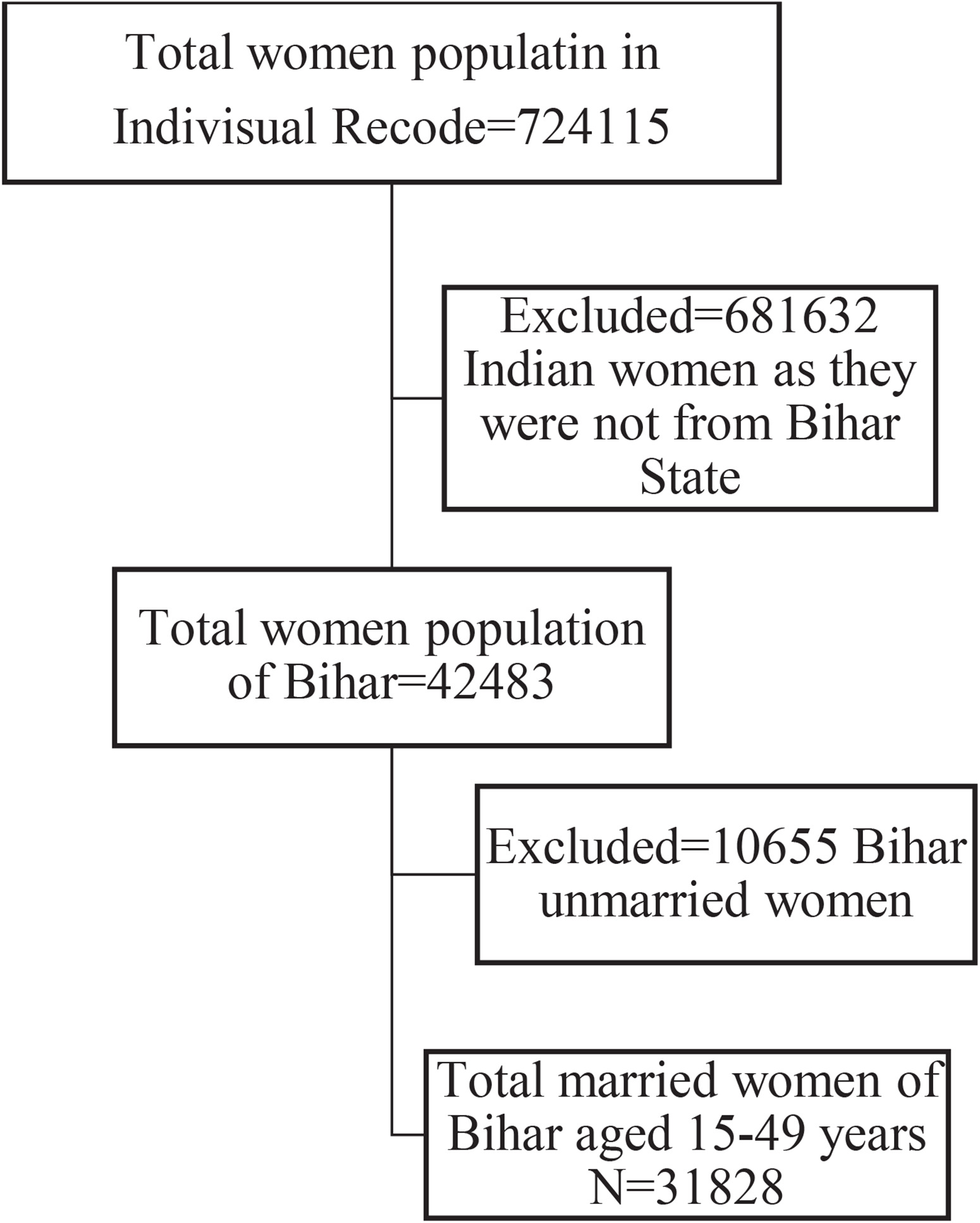
The present study uses data for Bihar only. The total Bihar sample comprised 42483 women aged 15–49 years, of whom 31828 were currently married and included in the study.
Eligibility criteria
Inclusion criteria were currently married women aged 15–49 years residing in Bihar, with complete data on contraceptive use and all covariates. The age range of 15–49 years is the standard reproductive age bracket used by NFHS and the WHO for family planning surveys23. It reflects the period of greatest reproductive risk and contraceptive need.
Exclusion criteria were women who were pregnant at the time of the survey (as their contraceptive status is contextually different), and records with missing data on any key variable.
Ethics
This study is based on publicly available, fully anonymized secondary data from NFHS-5. Ethical clearance for the primary NFHS-5 survey was obtained by IIPS from the Indian Council of Medical Research (ICMR). As the present study involves no primary data collection and uses fully anonymized datasets, no additional ethical approval was required.
Statistical tools
Microsoft Excel and STATA version 14.2 were used for data analysis. Descriptive statistics were used to present frequency and percentage distributions of sociodemographic variables and contraceptive use patterns. All analyses were conducted using survey-weighted procedures, applying the sampling weights provided in the NFHS-5 dataset to ensure state-representative estimates.
Dependent variable
Dependent variable was contraceptive use defined as current use of any modern or traditional contraceptive method at the time of the survey and coded as a binary outcome (1=currently using any method; 0=not using any method). Data were self-reported by respondents.
Potential covariates
The following independent variables were included based on theoretical relevance and prior literature, and are summarized in their full categorical form in Table 1. Age was recorded in five-year age groups (15–19, 20–24, 25–29, 30–34, 35–39, 40–44, and 45–49 years). Education level was recorded as illiterate, primary, secondary, and higher. Religion was recorded as Muslim, Hindu, Christian, and Other. Wealth index, an NFHS-constructed composite index, was recorded as poorest, poorer, middle, richer, richest. Area of residence was coded as rural versus urban. Media exposure was defined as whether the respondent was exposed to any media (radio, television, newspaper) at least once a week (0=no exposure, 1=exposed). Occupation was coded as unemployed versus employed.
Table 1
Sociodemographic profile of currently married women aged 15–49 years in Bihar, India, a cross-sectional secondary analysis of NFHS-5 data (2019–2021) (N=31828)
For the multivariable model reported in Table 2, each covariate was entered as a single ordinal or binary term rather than as a full set of category-specific dummy variables, so that every variable contributed exactly one degree of freedom to the model. Age, education level, and wealth index were entered as linear ordinal scores across their category levels; religion was collapsed into a binary indicator (Muslim=0 vs non-Muslim=1) because the Christian (0.07%) and Other (0.10%) religion categories were too small to support separate dummy coding; and area of residence, media exposure, and occupation retained their original binary coding. This single-term specification, applied consistently across all seven covariates, accounts for the seven degrees of freedom reported for the model [LR χ2(7)], and each adjusted odds ratio (ΑOR) in Table 2 should accordingly be interpreted as the effect of a one-category increase (for the ordinal variables) or of belonging to the non-reference group (for the binary variables), rather than as a comparison of each individual category against the reference.
Table 2
Adjusted logistic regression results showing determinants of contraceptive use among currently married women aged 15–49 years in Bihar, India, a cross-sectional secondary analysis of NFHS-5 (2019–2021) (N=6350)
| Variables | AOR | p | 95 % CI | |
|---|---|---|---|---|
| Lower | Upper | |||
| Age (ref: 15–19 years) | 0.54 | <0.001*** | 0.52 | 0.57 |
| Education level (ref: Illiterate) | 1.38 | <0.001*** | 1.19 | 1.60 |
| Religion (ref: Muslim) | 3.15 | <0.001*** | 2.58 | 3.83 |
| Wealth index (ref: Poorest) | 0.85 | 0.022* | 0.74 | 0.98 |
| Residence (ref: Rural) | 1.06 | 0.229 | 0.96 | 1.17 |
| Media exposure (ref: No exposure) | 6.83 | <0.001*** | 5.73 | 8.15 |
| Occupation (ref: Unemployed) | 0.96 | 0.634 | 0.82 | 1.13 |
| Constant | 8.34 | <0.001*** | 6.31 | 11.02 |
Caste (scheduled caste [SC], scheduled tribe [ST], other backward class [OBC], οther), summarized descriptively in Table 1, was not included as a covariate in the multivariable model. It was excluded because of substantial conceptual and empirical overlap with the wealth index and religion variables already in the model – caste category in Bihar is strongly patterned by both socioeconomic status and religious community – which raised concerns about multicollinearity and about the interpretability of an independent caste effect once these related variables were adjusted for. This decision, and its implications for interpreting caste as a determinant of contraceptive behavior in Bihar, is revisited in the Discussion.
Statistical analysis
Binary logistic regression was used to examine the factors influencing contraceptive use among currently married women in Bihar. Adjusted odds ratios (AORs) were calculated for each covariate, with age, education level, religion, wealth index, area of residence, media exposure, and occupation entered simultaneously into the model and mutually adjusted for one another.
Multicollinearity among the independent variables was assessed using the variance inflation factor (VIF); all VIF values were <5, indicating no serious multicollinearity. Although missing data on any single covariate were minimal (<2%), complete-case (listwise) deletion was applied jointly across all seven covariates and the outcome variable, and this joint criterion, combined with the exclusion of pregnant women, produced a substantially smaller analytic sample than the descriptive sample summarized in Table 1. Figure 1 shows the derivation of the descriptive sample (n=31828 currently married women); of these, 27140 were excluded for missing data on at least one covariate (occupation), yielding the final analytic sample of n=6350 used in the multivariable model in Table 2. Statistical significance was defined at p<0.05 (two-tailed).
RESULTS
Sociodemographic characteristics
The study encompassed 31828 currently married women aged 15–49 years in Bihar. Approximately 80% of the study population were Hindu and resided in rural areas. In terms of education, 47.19% had no formal education, 33.99% had secondary education, 12.12% had primary education, and 6.69% had higher education. The unemployment rate was 19.21%, while 42.44% of the study population fell into the poorest wealth category (Table 1).
Contraceptive method use
Figure 1 shows the derivation of the descriptive sample of currently married women (n=31828) from the total Bihar women’s sample. The further reduction to the n=6350 analytic sample used in the multivariable regression in Table 2, reflecting pregnancy exclusions and complete-case deletion across all covariates.
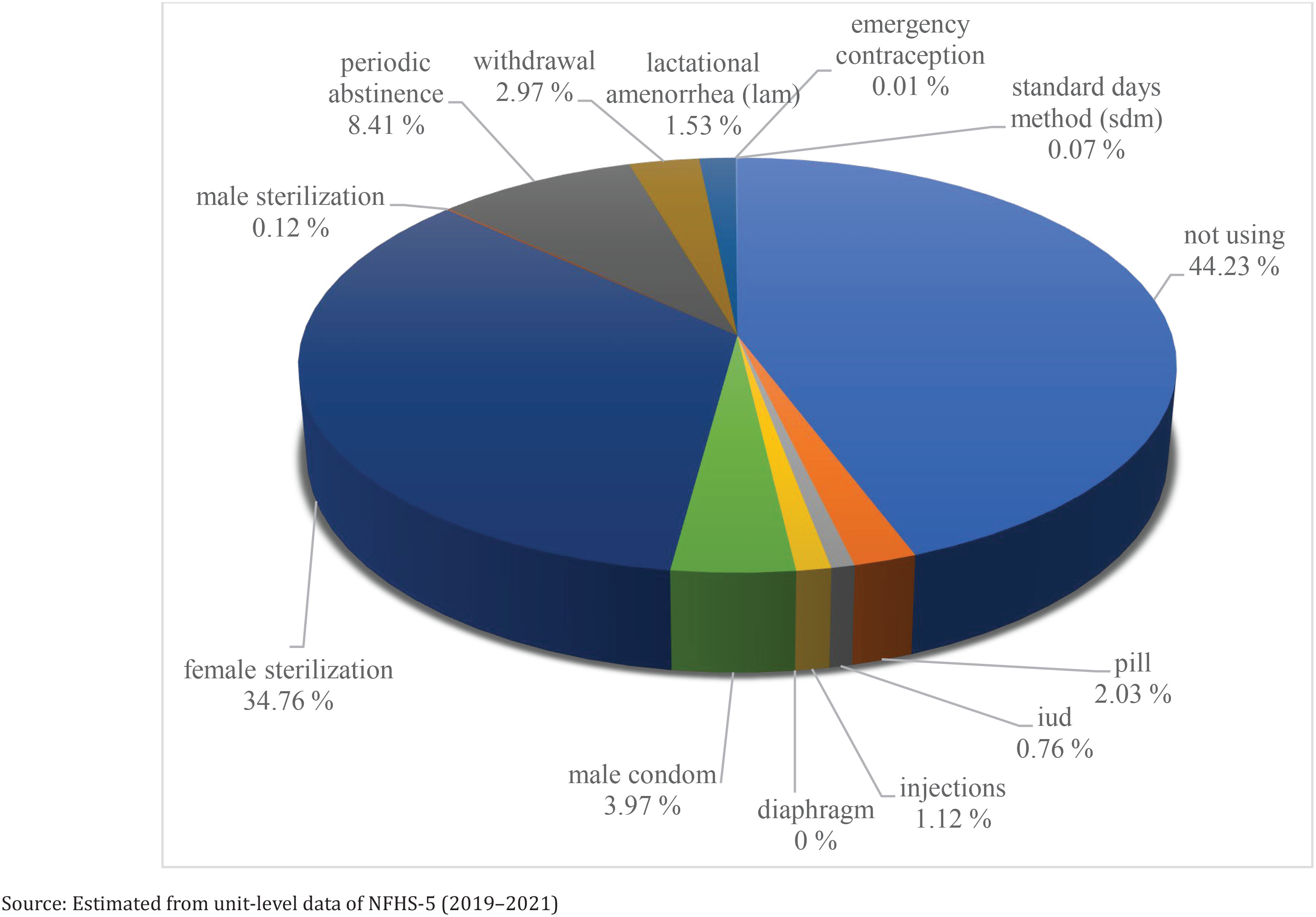
Figure 2 shows the distribution of contraceptive methods used by currently married women aged 15–49 years in Bihar during 2019–2021. The largest proportion of women (44.23%) were not using any contraceptive method. Among users, female sterilization was the most common method (34.76%), followed by periodic abstinence (8.41%), withdrawal (2.97%), male condoms (3.97%), and the pill (2.03%). IUDs (0.76%), injections (1.12%), LAM (1.53%), SDM (0.07%), emergency contraception (0.01%), and male sterilization (0.12%) were used by relatively few women.
Binary logistic regression results
A binary logistic regression analysis was conducted to examine the determinants of contraceptive use among currently married women aged 15–49 years in Bihar.
Age was negatively and significantly associated with contraceptive use (AOR=0.54; 95% CI: 0.52–0.57, p<0.001), indicating that with each increase in age category, the odds of using contraception decreased. Education level was positively associated with contraceptive use (AOR=1.38; 95% CI: 1.19–1.60, p<0.001). Religion showed a significant positive association (AOR=3.15; 95% CI: 2.59–3.83, p<0.001). Wealth index showed a small but significant negative association (AOR=0.85; 95% CI: 0.74–0.98, p=0.022). Place of residence was not statistically significant (AOR=1.06; 95% CI: 0.96–1.17, p=0.229). Media exposure was associated with substantially higher odds of contraceptive use (AOR=6.83; 95% CI: 5.73–8.15, p<0.001). Occupation was not statistically significant (AOR=0.96; 95% CI: 0.82–1.13, p=0.634). The model explained approximately 25.2% of the variation in contraceptive use (Pseudo R²=0.2519).
DISCUSSION
The present cross-sectional secondary analysis of NFHS-5 data examined the prevalence and sociodemographic determinants of contraceptive use among 31828 currently married women aged 15–49 years in Bihar, India. Key findings were that 44.23% of women were non-users, female sterilization dominated the method mix (34.76%), media exposure had the largest positive association with contraceptive use (AOR=6.83), age was negatively associated, and education and religion were significantly and positively associated.
Age showed a negative association with contraceptive use, indicating that older women were less likely to use contraception. This may reflect completed fertility and greater reliance on permanent methods such as sterilization among older women, rather than current reversible method use. These findings are consistent with studies from Nigeria and other low-income settings24,25. However, some studies in India have found that middle-aged women report higher contraceptive use than younger women, possibly because younger women face social pressure to prove fertility early in marriage – a discrepancy that may reflect differences in study design, sample composition, or regional context26.
Education had a strong positive effect, consistent with the broader literature showing that better educated women have greater awareness of contraceptive options and higher decision-making capacity10,27. Studies from Bihar and comparable low-income Indian states support this finding, noting that women with secondary or higher education are significantly more likely to use modern contraceptives17,28. In contrast, some studies have found that education effects diminish once wealth is controlled for, suggesting socioeconomic confounding; this was not assessed in the present study29.
Religion was significantly associated with contraceptive use, with non-Muslim women showing higher odds of use than Muslim women, reflecting the influence of socio-cultural and religious norms on reproductive decision-making18. These findings are consistent with national-level NFHS data showing lower contraceptive prevalence among Muslim women, though the magnitude may vary by state and urban/rural context30.
Media exposure emerged as the variable with the largest odds ratio (AOR=6.83), emphasizing the importance of information dissemination in shaping reproductive behavior. This is consistent with Ghosh et al.31, who found that mass media exposure was significantly associated with use of reversible modern contraceptives among married Indian women, with the effect being stronger in rural areas – where Bihar’s population is predominantly concentrated. The magnitude of this association (AOR=6.83) is large; however, given the cross-sectional design, reverse causality cannot be excluded (i.e. women who already use contraception may be more likely to seek health information from the media).
Wealth showed a modest negative association (AOR=0.85), which is unexpected and may reflect residual confounding or that wealthier women in Bihar have achieved desired family sizes and shifted to sterilization, thus not appearing as current users of reversible methods32. Place of residence and occupation were not statistically significant, suggesting a narrowing of the rural–urban gap and a limited direct influence of employment status on contraceptive use in this population. This finding of non-significant rural–urban differences is consistent with recent studies suggesting convergence in contraceptive prevalence across residence types in Bihar33.
Although caste was highlighted in the Introduction as an important Bihar-specific socio-cultural determinant of contraceptive behavior, alongside religion and standard of living18,19, it was not entered into the adjusted model reported here. Caste was omitted because of its substantial conceptual and empirical overlap with the wealth index and religion variables already central to the model, which raised concerns about multicollinearity and about isolating an independent caste effect. This is a limitation of the present analysis: caste-based inequities in contraceptive access and use are well documented in Bihar and elsewhere in India, and future work that model’s caste directly – ideally using methods more robust to collinearity, such as stratified or hierarchical models – is needed to disentangle these overlapping social determinants rather than to rely on wealth and religion as proxies for caste.
Female sterilization continues to dominate the method mix, consistent with prior studies34,35. The contraceptive method mix remains heavily skewed toward female sterilization, with limited use of modern spacing methods and minimal male participation, reflecting persistent gender norms36.
Strengths and limitations
Strengths of this study include its use of large, nationally representative NFHS-5 data with a substantial Bihar-specific sample (n=31828), application of survey-weighted logistic regression, and focus on the most recent available survey round.
Several limitations should be noted. First, the cross-sectional design precludes causal inference; all associations reported are descriptive, and causal directions cannot be established. Second, contraceptive use was based on self-reported measures, introducing the possibility of recall bias or social desirability bias. Third, residual confounding from unmeasured variables – such as spousal influence, access to health facilities, distance to services, and quality of care – cannot be excluded. Fourth, the discrepancy between the total married sample (n=31828) and the analytic sample used in logistic regression (n=6350) reflects the exclusion of pregnant women and cases with missing data, which may introduce selection bias. Fifth, caste, although highlighted in the Introduction as a Bihar-specific determinant of contraceptive behavior, was not included in the adjusted model because of its conceptual and empirical overlap with wealth index and religion; this precludes assessment of any caste-specific effect independent of these related variables.
CONCLUSIONS
This cross-sectional secondary analysis of NFHS-5 (2019–2021) data found that contraceptive use among currently married women aged 15–49 years in Bihar is significantly associated with age, education level, religion, wealth, and – most strongly – media exposure. Female sterilization continues to dominate the method mix, with limited use of modern reversible methods. However, given the cross-sectional study design, causal conclusions cannot be drawn. Future prospective and qualitative studies are needed to better understand barriers to contraceptive adoption in Bihar – particularly among younger women and those with unmet need – and to evaluate the causal impact of media and educational interventions on contraceptive use.