

INTRODUCTION
Tobacco use remains one of the leading preventable causes of morbidity and mortality globally, accounting for more than eight million deaths each year1. Most adult tobacco users initiate tobacco use during adolescence, making this period a critical window for prevention2. Early initiation is strongly associated with sustained tobacco use into adulthood and increased risk of non-communicable diseases, including cancer, cardiovascular disease, and chronic respiratory illnesses2. Adolescence represents a critical developmental stage characterized by increased vulnerability to risk behaviors but also heightened responsiveness to preventive interventions, underscoring the importance of early, school-based health education3,4.
At the global level, tobacco and substance use prevention is strongly guided by international policy frameworks. The World Health Organization Framework Convention on Tobacco Control (WHO FCTC) provides the primary global legal instrument for tobacco control, emphasizing education, communication, training, and public awareness as core demand-reduction strategies5. In addition, the WHO Global Action Plan for the Prevention and Control of Non-communicable Diseases highlights school-based health education as a key intervention for reducing behavioral risk factors, including tobacco and other substance use6. Broader substance-use prevention efforts are further reinforced by the United Nations Office on Drugs and Crime (UNODC) and WHO international standards, which advocate for early, school-based prevention programs targeting tobacco, alcohol, and other psychoactive substances among adolescents7.
School-based education is therefore a cornerstone of both tobacco-specific and broader substance-use prevention strategies. Evidence demonstrates that teaching adolescents about the harmful effects of tobacco use improves knowledge, shapes attitudes, and reduces the likelihood of experimentation and continued use8. Schools provide a structured and equitable platform for reaching adolescents before tobacco initiation occurs, particularly in low- and middle-income countries. Beyond tobacco-specific programs, whole-school health promotion approaches have been shown to improve health literacy and reduce substance use behaviors among adolescents, reinforcing the value of integrated prevention strategies within educational settings9-11.
In the African region, tobacco use among adolescents is an increasing public health concern. Although overall smoking prevalence remains lower than in some other regions, population growth, aggressive tobacco marketing, and expanding access to emerging products such as electronic cigarettes and shisha pose significant challenges12. The WHO African Region Tobacco Control Strategy calls for strengthened implementation of FCTC measures, including school-based tobacco education and protection of young people from tobacco promotion and exposure13. Regional evidence indicates that adolescents’ exposure to tobacco education varies by socioeconomic status, household smoking, peer influence, and media exposure, underscoring the need for targeted prevention strategies14,15.
In Zambia, tobacco and substance use prevention is guided by national policy frameworks aligned with global and regional commitments. Zambia is a Party to the WHO FCTC and has adopted national tobacco control measures that prioritize public awareness, health promotion, and youth protection16. In addition, Zambia’s broader National Alcohol and Drug Policy recognizes tobacco as a gateway substance and emphasizes prevention through education, particularly among adolescents and young people17. Despite these policy commitments, nationally representative evidence on adolescents’ exposure to school-based tobacco education remains limited.
The Global Youth Tobacco Survey (GYTS) 2021 provides a unique opportunity to assess adolescents’ exposure to tobacco-related education in Zambia and to examine factors associated with learning about the harmful effects of tobacco use in school. Using data from GYTS 2021, this analysis investigates individual, social, and environmental factors associated with being taught about the dangers of tobacco use among Zambian adolescents. Findings from this study aim to inform the implementation of national tobacco and substance-use prevention policies and strengthen school-based health education strategies in Zambia.
METHODS
Study design and data source
This study is a secondary analysis of data from the Global Youth Tobacco Survey (GYTS) 2021 conducted in Zambia. GYTS is a nationally representative, school-based cross-sectional survey designed to monitor tobacco use, exposure to tobacco-related information, and tobacco control indicators among adolescents aged 11–17 years. The survey was coordinated by the World Health Organization (WHO) and the U.S. Centres for Disease Control and Prevention (CDC) and is implemented using a standardized methodology to ensure comparability across countries and survey waves18,19.
The Zambia GYTS 2021 employed a two-stage cluster sampling design to obtain a representative sample of students in Grades 7–9. In the first stage, schools were selected with probability proportional to enrolment size. In the second stage, classes within selected schools were randomly sampled, and all students in selected classes were eligible to participate. The survey used anonymous, self-administered questionnaires completed during regular school hours.
Study population
The analytic sample included adolescents aged 11–17 years who participated in the Zambia GYTS 2021 and had non-missing data for the outcome variable of interest. Students with missing responses to the outcome variable were excluded from the analysis. The final weighted analytic sample consisted of 6499 adolescents.
Variables
The variables used in this study were derived from the Zambia Global Youth Tobacco Survey (GYTS) 2021 questionnaire. Table 1 presents the variables included in the analysis, their corresponding survey items, and the categories used for analysis.
Table 1
Variables and coding for analysis of learning about harmful effects of tobacco among Zambian adolescents (GYTS 2021)
Outcome variable
The primary outcome variable for this analysis was learning about the harmful effects of tobacco use in school, derived from survey item CR33 (During the past 12 months, were you taught in any of your classes about the dangers of tobacco use?). This variable was operationalized as a binary outcome: Yes (1): learner reported being taught in any class about the dangers of tobacco use during the past 12 months (CR33=1); and No/Don’t know (0): learner reported not being taught or did not know (CR33=2 or 3).
Explanatory variables
Explanatory variables were selected based on existing literature and the conceptual framework used in earlier GYTS analyses. Sociodemographic variables included age (derived from CR1 and treated as a categorical variable), sex (CR2), and grade level (ZAR3). Age, sex, and grade were included a priori in all adjusted models. Additional explanatory variables captured individual behaviors, social influences, and environmental exposures relevant to tobacco education and use. These included: ever tried cigarette smoking (CR5), exposure to anti-tobacco media messages (CR30), intention to use tobacco in the next five years (CR40), parental or guardian smoking in the home (OR15), having friends who smoke tobacco (ZAR55), seeing people smoke at school (CR22), seeing teachers smoke at school (OR60), exposure to tobacco advertising (CR35), and exposure to tobacco use on television or other media (CR34). For consistency and interpretability, all explanatory variables were recoded as binary factors (Yes, No) prior to analysis.
Missing data
Observations with missing values for the outcome variable were excluded from the analysis20,21. For explanatory variables, missing observations were handled through list wise deletion within regression models. The proportion of missing data was small and unlikely to materially affect the results.
Statistical analysis
All analyses accounted for the complex survey design of GYTS, incorporating sampling weights, stratification, and primary sampling units (PSUs) to produce nationally representative estimates. Descriptive analyses were conducted to summarize sample characteristics using weighted proportions and 95% confidence intervals.
Weighted prevalence estimates of learning about the harmful effects of tobacco were calculated across key sociodemographic and behavioral variables. Crude (unadjusted) logistic regression models were first fitted to examine associations between each explanatory variable and the outcome20,21. Subsequently, multivariable logistic regression models were estimated to identify factors independently associated with learning about the harmful effects of tobacco use.
Adjusted models included age, sex, and grade level a priori. Additional variables were selected using a stepwise model selection approach based on the Akaike information criterion (AIC). Adjusted odds ratios (ORs) with 95% confidence intervals are reported. Sensitivity analyses were conducted to assess the robustness of findings to alternative model specifications.
All statistical analyses were conducted using survey-weighted procedures in R 4.5.2, and statistical significance was assessed at the 5% level.
Ethical considerations
The GYTS protocol received ethical approval at the national level prior to data collection. Participation in the survey was voluntary, and informed consent procedures were followed in accordance with national guidelines. This secondary analysis used anonymized, publicly available data and did not require additional ethical approval.
RESULTS
Participant characteristics
A total of 6499 adolescents were included in the analysis (Table 2). The median age was 14 years (IQR: 13–16). Over half of participants were aged 13–14 years (52%), followed by 15–16 years (37%), while 11% were aged ≥17 years. Females constituted 57% of the sample, and males 43%. Participants were relatively evenly distributed across grade levels, with 35% in Grade 7, 32% in Grade 8, and 33% in Grade 9.
Table 2
Characteristics of adolescents who reported learning about the harmful effects of tobacco in Zambia, 2021 Global Youth Tobacco Survey (N=6499)
Overall, 47% (n=3004) of adolescents reported that they had learned about the harmful effects of tobacco use in school during the past 12 months. More than half of participants were classified in the low wealth index category (53%), while 18% and 29% were in the middle and high wealth categories, respectively.
Regarding tobacco-related behaviors and exposures, 21% reported ever trying cigarette smoking, 16% reported having smoked cigarettes, and 18% reported having tried shisha. Approximately 27% had heard of electronic cigarettes. Exposure to tobacco use in the school environment was reported by 25% of participants, while 14% reported seeing teachers smoke at school. Nearly half (45%) reported seeing people using tobacco on television, and 21% reported exposure to tobacco advertisements. Awareness of tobacco-related health risks varied, with 57% reporting knowledge that long-term tobacco use leads to cancer and 39% reporting knowledge that it leads to drug use.
Prevalence of learning about the harmful effects of tobacco
The weighted prevalence of learning about the harmful effects of tobacco varied across demographic, behavioral, and environmental characteristics (Table 3). Prevalence declined with increasing age, from 48.8% (95% CI: 47.11–50.50) among adolescents aged 13–14 years to 40.4% (95% CI: 36.63–44.10) among those aged ≥17 years. Adolescents who had never tried cigarette smoking reported a higher prevalence of learning about harmful effects (53.55%; 95% CI: 51.99–55.10) compared with those who had tried smoking (42.09%; 95% CI: 39.12–45.06).
Table 3
Weighted prevalence of adolescents who reported learning about the harmful effects of tobacco, by demographic and behavioral characteristics, Zambia, 2021 Global Youth Tobacco Survey (N=6499)
| Characteristics | Percentage* (95% CI) |
|---|---|
| Overall | 47.00 (45.79–48.21) |
| Age (years) | |
| 13–14 | 48.80 (47.11–50.50) |
| 15–16 | 45.87 (43.86–47.88) |
| ≥17 | 40.36 (36.63–44.10) |
| Ever tried cigarette smoking | |
| No | 53.55 (51.99–55.10) |
| Yes | 42.09 (39.12–45.06) |
| Exposure to anti-tobacco media messages | |
| No | 38.02 (36.36–39.67) |
| Yes | 57.21 (55.42–58.99) |
| Father smokes | |
| No | 46.76 (45.42–48.10) |
| Yes | 47.32 (44.23–50.40) |
| Friends smoke tobacco | |
| No | 55.12 (53.26–56.99) |
| Yes | 46.45 (43.99–48.91) |
| Grade | |
| Grade 7 | 45.69 (43.63–47.74) |
| Grade 8 | 45.76 (43.59–47.93) |
| Grade 9 | 49.34 (47.17–51.51) |
| Heard of electronic cigarette | |
| No | 46.86 (45.41–48.30) |
| Yes | 47.62 (45.25–50.00) |
| Intention to use tobacco in next 5 years | |
| Definitely not | 50.62 (49.14–52.10) |
| Definitely yes | 37.03 (32.43–41.63) |
| Probably not | 39.46 (36.60–42.33) |
| Probably yes | 38.07 (33.39–42.75) |
| Long-term tobacco use leads to drug use | |
| No | 37.82 (36.30–39.35) |
| Yes | 60.84 (58.94–62.75) |
| Long-term tobacco use leads to cancer | |
| No | 29.10 (27.39–30.80) |
| Yes | 60.03 (58.45–61.61) |
| Own item with tobacco product | |
| No | 46.64 (45.34–47.94) |
| Yes | 48.69 (45.14–52.24) |
| Parent/guardian smokes in home | |
| About every day | 47.99 (43.22–52.76) |
| No | 38.58 (35.89–41.26) |
| Never | 49.30 (47.77–50.84) |
| Sometimes | 46.83 (42.77–50.88) |
| People smoke in school | |
| No | 45.78 (44.37–47.19) |
| Yes | 45.78 (44.37–47.19) |
| Saw teachers smoking at school | |
| No | 51.21 (49.69–52.74) |
| Yes | 37.98 (34.74–41.22) |
| See people using tobacco on TV | |
| No | 39.06 (37.44–40.68) |
| Yes | 56.23 (54.43–58.03) |
| See tobacco advertisement | |
| No | 46.09 (44.72–47.47) |
| Yes | 49.85 (47.18–52.52) |
| Sex | |
| Female | 47.77 (46.14–49.39) |
| Male | 45.98 (44.09–47.86) |
| Smoked cigarettes | |
| No | 50.56 (49.13–51.99) |
| Yes | 38.30 (35.11–41.49) |
| Teachers smoke at school | |
| No | 48.32 (47.00–49.64) |
| Yes | 38.03 (34.85–41.22) |
| Tried shisha | |
| No | 47.83 (46.47–49.18) |
| Yes | 43.19 (40.32–46.06) |
| Use of hand rolled cigarette | |
| No | 49.42 (48.04–50.79) |
| Yes | 37.35 (34.76–39.94) |
| Wealth index | |
| Low | 45.89 (44.21–47.57) |
| Middle | 51.78 (48.86–54.70) |
| High | 46.12 (43.86–48.39) |
Exposure to anti-tobacco media messages was associated with a higher prevalence of learning about harmful effects (57.21%; 95% CI: 55.42–58.99) compared with those not exposed (38.02%; 95% CI: 36.36–39.67). Similarly, higher prevalence was observed among adolescents who knew that long-term tobacco use leads to cancer (60.03%; 95% CI: 58.45–61.61) or drug use (60.84%; 95% CI: 58.94–62.75), compared with those without this knowledge (29.10%; 95% CI: 27.39–30.80) and (37.82%; 95% CI: 36.30–39.35), respectively.
Lower prevalence of learning about harmful effects was observed among adolescents who reported seeing teachers smoke at school (37.98%; 95% CI: 34.74–41.22) compared with those who did not (51.21%; 95% CI: 49.69–52.74), and among those who reported using hand-rolled cigarettes (37.35%; 95% CI: 34.76–39.94) compared with non-users (49.42%; 95% CI: 48.04–50.79). Differences were also observed across wealth categories, with the highest prevalence reported among adolescents in the middle wealth index (51.78%; 95% CI: 48.86–54.70).
Factors associated with learning about the harmful effects of tobacco
Results from the multivariable logistic regression analysis are presented in Figure 1. After adjustment for age, sex, and grade level, exposure to anti-tobacco media messages was positively associated with learning about the harmful effects of tobacco (AOR=1.63; 95% CI: 1.36–1.94; p<0.001). Adolescents who reported seeing people use tobacco on television also had higher odds of learning about harmful effects (AOR=1.43; 95% CI: 1.20–1.71; p<0.001).
Figure 1
Adjusted odds ratios for learning about dangers of smoking in Zambia based on the 2021 Global Youth Tobacco Survey (N=6499)
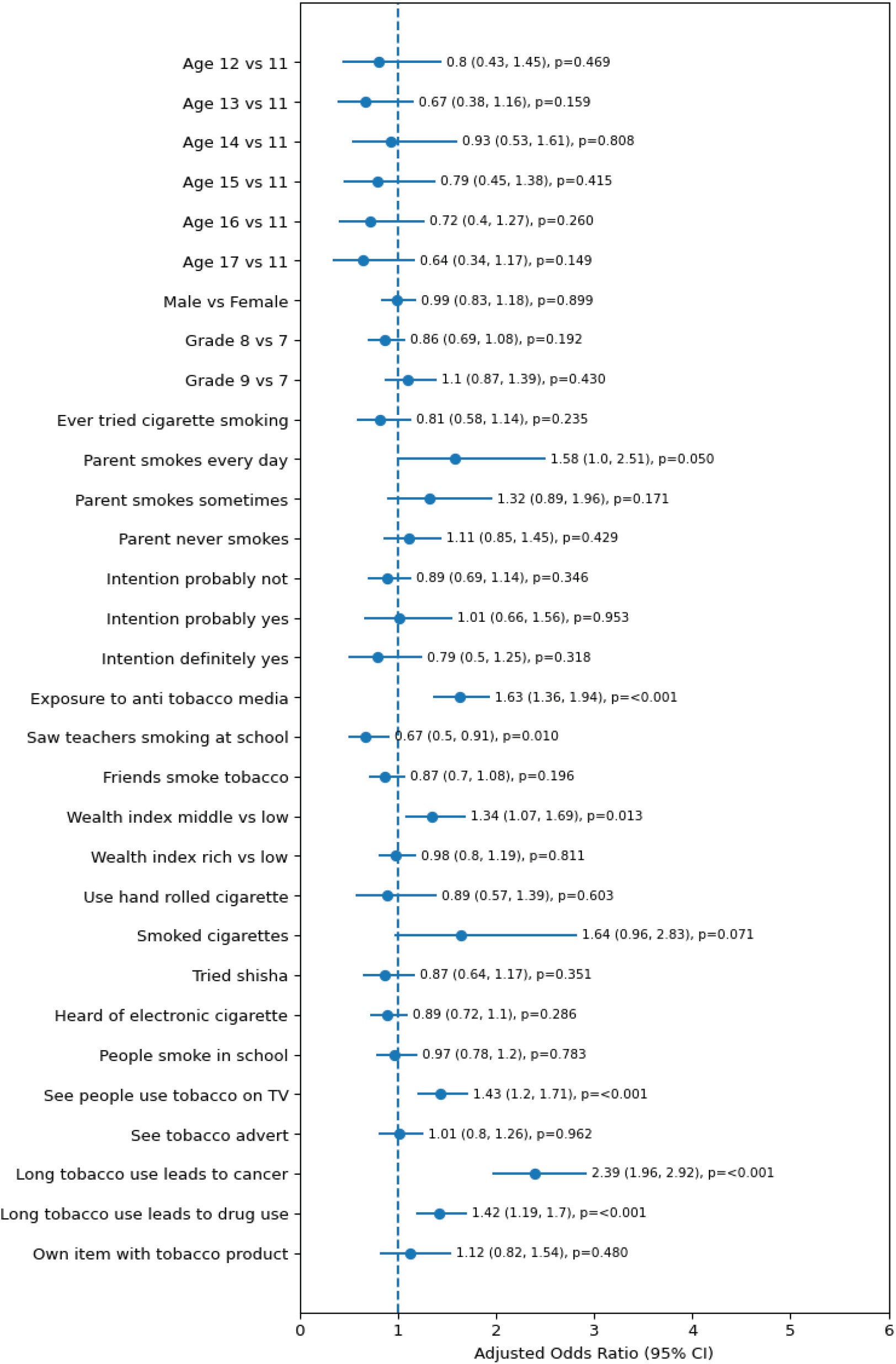
Knowledge that long-term tobacco use leads to cancer (AOR=2.39; 95% CI: 1.96–2.92; p<0.001) and drug use (AOR=1.42; 95% CI: 1.19–1.70; p<0.001) was strongly associated with the outcome. Adolescents in the middle wealth index had higher odds of learning about harmful effects compared with those in the low wealth index (AOR=1.34; 95% CI: 1.07–1.69; p=0.013).
In contrast, adolescents who reported seeing teachers smoke at school had lower odds of learning about the harmful effects of tobacco (AOR=0.67; 95% CI: 0.50–0.91; p=0.010). No statistically significant associations were observed for age, sex, grade level, ever trying cigarette smoking, peer smoking, or intention to use tobacco in the next five years after adjustment.
DISCUSSION
This analysis examined factors associated with adolescents learning about the harmful effects of tobacco use in school using data from the Zambia Global Youth Tobacco Survey (GYTS) 2021. Less than half of adolescents reported being taught about the dangers of tobacco use in school, highlighting persistent gaps in school-based tobacco education despite strong global, regional, and national policy commitments.
At the global level, school-based tobacco education is recognized as a cornerstone of youth tobacco prevention under the WHO Framework Convention on Tobacco Control (FCTC) and broader non-communicable disease prevention strategies3,4. However, evidence from multiple countries indicates that implementation of school-based tobacco education remains uneven, particularly in low- and middle-income settings13,14. The overall prevalence observed in this study is consistent with findings from other GYTS-based analyses, which show that a substantial proportion of adolescents do not receive structured education on the harmful effects of tobacco use despite attending school15.
Exposure to anti-tobacco media messages emerged as one of the strongest predictors of learning about the harmful effects of tobacco. This finding aligns with global evidence demonstrating that mass media campaigns complement school-based education by reinforcing health messages and increasing awareness among adolescents16,17. The WHO FCTC explicitly recommends the use of mass media to support tobacco education and counter pro-tobacco messaging3. Our findings suggest that, in Zambia, media exposure may partially compensate for gaps in formal classroom-based tobacco education.
Consistent with previous studies, adolescents who demonstrated knowledge of tobacco-related health risks – particularly awareness that long-term tobacco use leads to cancer and drug use – were significantly more likely to report having learned about harmful effects in school18,19. This likely reflects the content of tobacco education curricula, which often emphasize long-term health consequences. However, it may also indicate that adolescents who are more engaged with health information are better able to recall or recognize tobacco-related instruction.
In the African region, tobacco use among adolescents is influenced by a complex interplay of social, environmental, and institutional factors7,8. The observed lower odds of learning about harmful effects among adolescents who reported seeing teachers smoke at school is particularly concerning. Teachers play a critical role as role models, and their tobacco use within school settings may undermine health education messages and weaken the perceived credibility of tobacco prevention efforts21,22. Similar associations have been documented in other African and low-income country settings, where tobacco use by school staff has been linked to weaker tobacco norms and poorer student outcomes23.
The association between household smoking exposure and learning about harmful effects was modest in adjusted models, with only daily parental smoking reaching borderline statistical significance. Previous studies have shown mixed findings regarding parental smoking and adolescents’ exposure to tobacco education, suggesting that household smoking may influence attitudes and behaviors more strongly than formal learning opportunities24,25. In contrast, peer smoking was not independently associated with learning about harmful effects after adjustment, underscoring that peer influence may shape tobacco use behaviors rather than access to health education.
Socioeconomic differences were also evident, with adolescents in the middle wealth index more likely to report learning about harmful effects compared with those in the low wealth group. Similar socioeconomic gradients in access to school-based health education have been reported globally and within Sub-Saharan Africa, reflecting disparities in school resources, teacher training, and curriculum implementation26-28.
From a national perspective, Zambia is a Party to the WHO FCTC and has adopted national tobacco control and substance-use policies that emphasize prevention through education, particularly among young people11,12. The findings of this study suggest that translating these policy commitments into consistent, high-quality school-based tobacco education remains a challenge. Strengthening teacher training, enforcing smoke-free school environments, and integrating tobacco education within broader health and life-skills curricula may be critical to improving coverage and effectiveness.
Limitations
This study has several limitations. First, it relied on self-reported data, which may introduce misclassification of exposure to school-based tobacco education and other variables. Second, the cross-sectional design limits causal inference and cannot establish temporality between exposures and outcomes. In addition, residual confounding may remain despite adjustment for several sociodemographic and behavioral variables. Furthermore, because the data were collected from school-going adolescents in Zambia, the findings may have limited generalizability to adolescents who are not enrolled in school or to populations in other countries.
Implications
Despite strong global and national policy frameworks, a substantial proportion of Zambian adolescents did not report learning about the harmful effects of tobacco in school. Integrating school-based education with mass media campaigns, strengthening enforcement of smoke-free school policies, and addressing socioeconomic disparities in education delivery may enhance the effectiveness of tobacco prevention efforts among adolescents.
CONCLUSIONS
This study found that fewer than half of Zambian adolescents reported learning about the harmful effects of tobacco use in school, despite existing global, regional, and national commitments to youth tobacco prevention. Exposure to anti-tobacco media messages, awareness of tobacco-related health risks, and socioeconomic status were positively associated with learning about harmful effects, while exposure to teachers smoking at school was negatively associated with this outcome.
These findings highlight gaps in adolescents’ exposure to school-based tobacco education in Zambia. Further studies are needed to better understand the factors influencing access to and effectiveness of tobacco education programs in schools, as well as how school-based interventions interact with broader social and media influences on adolescent tobacco-related knowledge and behaviors.