

INTRODUCTION
Medical personnel are professional workers whose skills and competence are required to provide services in hospitals1. However, these competencies are not enough if they are not accompanied by ethical and moral values when carrying out professional duties2. A person’s ethics truly determine their identity when in society, especially for health workers providing services to the community, both those in need of medical treatment and those seeking consultations3.
Medical personnel, in executing their roles and functions, are in direct contact with patients, where even a slight mistake can have various impacts, not only on social communication but also leading to legal problems4. Compliance with standard operational procedures in providing services to the public, especially in government hospitals, is insufficient without being accompanied by ethical and moral values, which are obligations upheld by medical and paramedical personnel5.
The International Medical Ethics has established that doctors and other medical personnel are obligated to act in the best interests of patients, strengthening the identification of patients’ physical and psychological conditions during the delivery of health services6. However, ethical dilemmas in health services often arise due to various factors that can have widespread impacts on patients and hospitals alike. Professionals in healthcare often confront ethical issues related to end-of-life care, resuscitation, consent, competency, care and treatment decisions, and overall hospital healthcare management7.
Ethics in health services has been positioned as an integral part of the daily activities of health workers in any health facility carrying out their duties, especially in government-managed hospitals in Indonesia, including those in Palu City, Central Sulawesi Province. Ethical health service practices are highly sensitive matters that are integral to the professionalism of health service providers, particularly in government hospitals8.
Adequate medical actions, when not accompanied by good health service ethical practices, can lead to unsatisfactory case management and handling, resulting in paralyzed services that hinder the improvement of service quality9. Although ethical principles of health services can be widely accepted and are universally recognized in various countries, each country may make specific modifications, create frameworks, and interpretations in line with the philosophical, spiritual views, and principles of healthcare practices existing within the health system10. This adaptation should align with the prevailing culture in a country or region11, including local customs in Palu City, when health workers interact with each other or with the community in need of services.
Hospitals managed by the government are organizations with the function of providing services in the health sector, aiming to improve public health in line with the government’s vision and mission to enhance the welfare of its people12. In this context, every hospital must possess the capability to handle various issues, especially those related to the moral ethics of health workers employed in hospitals, while upholding the essence of professionalism.
Individuals in need of medical services do not merely seek medical treatment based on diagnoses; they also value the preservation of social norms in their interactions because this significantly influences their satisfaction with the medical services received13. Appropriate medical actions, aligned with diagnoses, can cure a patient’s illness, but patient satisfaction is profoundly impacted by friendly and ethical interactions14. A warm attitude coupled with a smile can have a positive psychological effect on patients, potentially aiding in a quicker recovery or inspiring the enthusiasm to face life despite illness15.
Many hospital visitors express dissatisfaction not primarily due to lacking facilities or infrastructure supporting hospital operations, but rather due to nontechnical aspects such as ineffective communication, perceived ineptitude, disrespectful behavior, and the clarity of information provided to patients about necessary actions and consultations16. Clear instructions and guidance within the hospital setting are crucial, helping patients navigate their way and preventing confusion17. Patients left waiting in queues without guidance can experience reduced satisfaction due to this lack of non-medical service, even though it does not involve direct medical treatment18.
Several barriers act as determining factors influencing the ethical behavior of health workers. These include the prevailing culture and norms within government hospital organizations, the degree of supervision and control over health workers’ conduct, and the level of ethical education and training they receive19. Moreover, high work pressure, organizational policies, and limited resources can also serve as significant hindrances20. Additionally, an individual’s personal and moral values, ethical awareness, adherence to regulations, and compliance with medical ethics also contribute to shaping health workers’ ethics21.
It is crucial to identify and understand the key factors that shape the attitudes and ethics of healthcare workers in carrying out their professional responsibilities in hospitals. These factors include organizational culture, supervision and control, training and education, work pressure, organizational policies, resource limitations, communication and transparency, personal and moral values, compliance with regulations, and ethical awareness. The aim of this study is to identify the most influential factors affecting the ethical values of healthcare professionals while delivering services in government hospitals in Palu, Central Sulawesi, Indonesia.
METHODS
Research design
This study was conducted in Palu City, Indonesia, in 2023, focusing on three government hospitals: Undata Hospital, Anutapura Hospital, and Madani Hospital. These hospitals are well-established and widely recognized within the community.
The research utilized a cross-sectional quantitative observational approach to evaluate the ethical practices of healthcare workers in these hospitals. The study specifically targeted healthcare professionals working in the Emergency Departments (ED) of these institutions, as ED staff frequently engage with patients in urgent situations, making their ethical conduct particularly critical. Participants were selected from various roles within the ED to ensure a comprehensive representation of healthcare workers in this setting.
The research protocol received approval from the Medical and Health Research Ethics Committee of the Faculty of Medicine at Tadulako University. The approval number is 7232/UN 28.1.30/KL/2023, and the approval date is 5 September 2023. The committee has confirmed that the protocol adheres to the ethical principles outlined in the Declarations of Helsinki 2008. All participants were also asked to provide informed consent before participating in this study. We have submitted all reporting documents to the ethics committee, including progress reports, serious adverse event (KTD) reports, and a final report upon completion of the study, as required by the ethics committee.
The study also analyzed various determinant factors influencing the ethical practices of health workers. These factors included organizational culture, supervision and control, training and education, work pressure, organizational policies, resource limitations, communication and transparency, personal and moral values, compliance with regulations, and ethical awareness. These factors were explored to understand their impact on the professional ethics of health workers in government hospitals.
Determinant factors and respondents
This study explored seven determinant factors, assessed by a total of 30 respondents selected from the ED and Polyclinic sections of the hospitals. The respondents were asked to provide their perceptions on each factor using a 5-point Likert scale. The factors were analyzed through principal component analysis (PCA) to identify the primary components influencing the ethical values of healthcare workers in their professional duties. These factors included: Communication skills (X1); Medical knowledge and skills (X2); Ethics education and training (X3); Working environmental conditions (X4); Organizational norms and work culture (X5); Professional responsibility (X6); and Patient and family attitudes (X7). The illustration of respondents and determining factors of moral attitudes and ethics for health workers and the dataset of determinant factors towards the ethical values attitudes of health workers when providing services in government hospitals can be found in the Supplementary file.
The 30 respondents were selected using a convenience sampling method. Of these, 15 worked in the Emergency Department (ED), and 15 worked in the Polyclinic section, ensuring a balanced representation across both settings. The sample consisted of 10 doctors, 10 nurses, and 10 co-assistants (medical students undergoing a mandatory professional program for medical majors). The selection was based on a combination of experience levels, with doctors and nurses having more professional experience compared to the co-assistants, ensuring a diverse range of perspectives.
Basic considerations for PCA
The principal component analysis (PCA) method is widely utilized to condense the number of significant determinant factors, emphasizing components with high eigenvalues that have substantial influence on variance. In the context of moral and ethical values in health services within government hospitals, 7 factors within the dataset are instrumental. Through PCA, these factors are condensed into two or three new determinant factors known as principal components (PCs). These seven determinant factors are intrinsic to the management culture of Indonesian hospitals and are inseparable from the overall organizational management.
Calculation and determination of principal components (PCs)
The principal component analysis (PCA) methodology is used to solve eigenvalue problems. Essentially, PCA calculations are grounded in multiple eigenvalues (λ), which are determined through covariance calculations.
The PCA algorithm generally calculates the covariance matrix, which represents the relationship between the variables. This matrix is computed as the sum of the product of the variables (x and y) divided by the number of data points, minus the product of their respective means. Next, the eigenvalues are determined by solving the characteristic equation, where the matrix (A) minus the eigenvalue (λ) times the identity matrix (I) equals zero.
Once the eigenvalues are determined, the corresponding eigenvectors are found by solving the equation where the matrix (A) minus the eigenvalue times the identity matrix (I) is multiplied by the eigenvector matrix (X), resulting in a null vector. A new variable, known as the principal component (PC), is then derived by multiplying the original variable with the eigenvector matrix.
Additionally, the variance explained by the first principal component is determined by calculating the contribution of each eigenvalue. The contribution of each eigenvalue is given by dividing the eigenvalue by the sum of all eigenvalues and multiplying by 100 to express the result as a percentage.
RESULTS
Correlation between variables
The ethical and moral attitudes of health workers while providing services to the public or patients in three hospitals are influenced by seven determinant factors, each showing correlations between variables. The results of the correlation test reveal a significant correlation between the communication ability variable (X1) and the knowledge and skills (X2) of health workers, with a correlation coefficient of 0.58 (greater than α = 0.001). Similarly, a significant correlation is found between working environmental conditions (X4) and communication skills (X1) of health workers, with a correlation coefficient of 0.50 (greater than or equal to α = 0.01). This indicates a mutual influence between these variables, though not all correlations are statistically significant, as shown in Table 1.
Table 1
Correlation results between variables (Xn) as determining factors in the moral ethics value (Y) of health workers in three government hospitals in Palu City, a cross-sectional study, Indonesia, 2023 (N=30)
| Variable factor (X) | Variable factor (X) | |||||||
|---|---|---|---|---|---|---|---|---|
| X1 | X2 | X3 | X4 | X5 | X6 | X7 | Y | |
| X1: Communication skills | 1 | |||||||
| X2: Medical knowledge/skill | 0.58** | 1 | ||||||
| X3: Ethics education and training | -0.12 | -0.03 | 1 | |||||
| X4: Working environment conditions | 0.51** | 0.70** | 0.02 | 1 | ||||
| X5: Organizational norms and work culture | 0.45* | 0.14 | -0.10 | -0.15 | 1 | |||
| X6: Professional responsibilities | 0.19* | -0.05 | 0.11 | -0.16 | 0.09 | 1 | ||
| X7: Patient and family attitudes | 0.45* | 0.49* | 0.09 | 0.54* | 0.19 | -0.20 | 1 | |
| Y: Ethical values of health workers | 0.73 | 0.45 | -0.17 | 0.17 | 0.48 | 0.34 | 0.40 | 1 |
The correlation between communication skills (X1) and working environment conditions (X4) among health workers, concerning their ethical and moral values when providing services, along with other correlated variables, is presented in Table 1.
The results of the principal component analysis (PCA) demonstrate three factors with eigenvalues ≥1, as shown in Table 2. In this table, these three factors transform into principal components (PCs) based on the obtained eigenvalues: communication skills (F1), organizational norms and work culture (F2), and knowledge/skills (F3) of health workers.
Table 2
Eigenvalue, variability, and cumulative variability from principal component analysis on factors influencing ethical values of health workers in three government hospitals in Palu City, a cross-sectional study, Indonesia, 2023 (N=30)
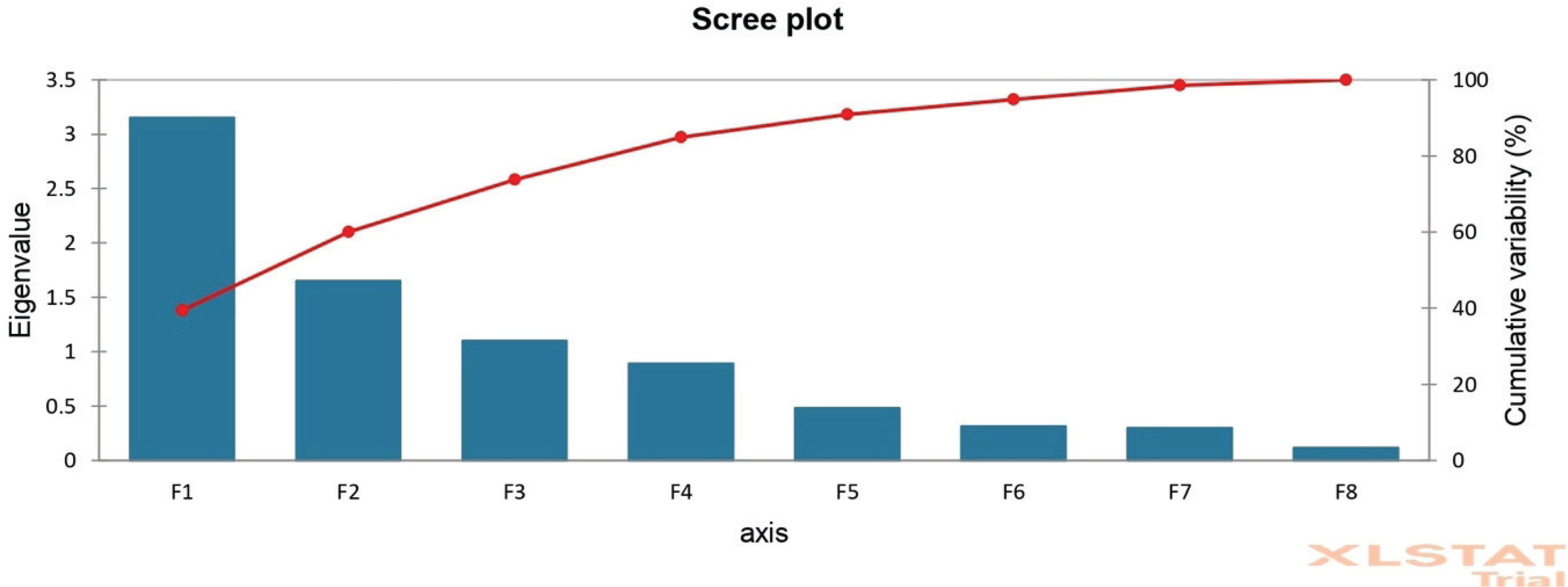
Based on Table 2, the first principal component (PC1) represents the communication skills of health workers and accounts for 39.40% of the variance in moral ethics values when serving patients. It is followed by organizational norms and work culture (PC2) in hospitals, contributing 20.64% of the variance in moral ethics values. The third principal component (PC3) signifies the degree of knowledge and skills, contributing 13.77% of the variance in the moral ethics values of health workers. These three PCs collectively influence 73.80% of the variance in the moral ethics values of health workers, a substantial amount that significantly shapes the ethical attitude of health workers when serving patients in three government hospitals.
The three factors with the highest eigenvalues influencing the variance in the ethical values of health workers can be observed in Figure 1. Factors F1 through F3 exhibit substantial drops, while from F4 to F7, the influence gradually diminishes. The low eigenvalues of F4 to F7 do not imply they have no impact on the ethical values of health workers, but their influence is significantly smaller and less significant when compared to F1, F2, and F3 as PC1, PC2, and PC3.
Figure 1
Scree plot of eigenvalue and cumulative variability (%) for the determinants of ethical values of health workers in three government hospitals in Palu City, a cross-sectional study, Indonesia, 2023 (N=30)
The dynamics of these data are directly related to communication skills supported by hospital organizational norms and medical knowledge as energy for every health worker. Figure 2 shows the angle of each factor, which illustrates the influence of each factor on the moral ethical values of health workers in government hospitals in Palu City.
Figure 2
Biplot of active variables and active observations for ethical values of health workers in three government hospitals in Palu City, a cross-sectional study, Indonesia, 2023 (N=30)
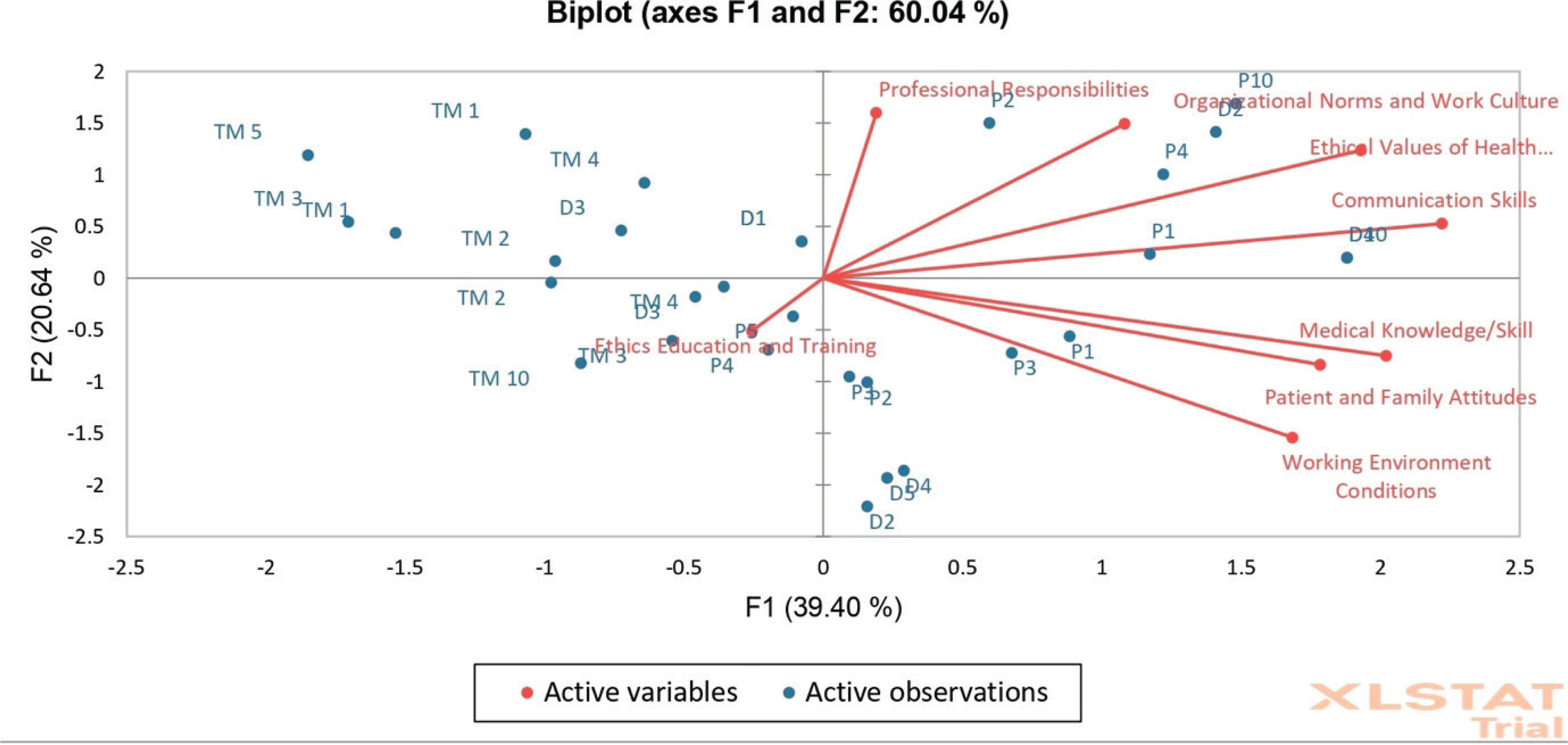
The smallest line angles for the ethical values of health workers are attributed to communication skills (PC1), organizational norms in hospitals (PC2), and the education of health workers (PC3). The contribution of F1 and F2 as main components accumulatively reaches 60.04%; therefore, these two main components can be categorized as determinants of the variance in ethical values of health workers out of a total of 100%.
DISCUSSION
Based on the research findings, it can be concluded that three primary factors determine the ethical values of health workers when they provide services, these are knowledge/skills, organizational norms and work culture, and communication skills. Health workers who provide services with good attitudes and ethics do so because of their confident demeanor when interacting with the public, particularly with patients in need of services. Self-confidence does not simply manifest; it is a result of a process, either through training and additional education or gained from professional experience. Self-confidence is an essential asset for every health worker, particularly when addressing questions or concerns about patients’ symptoms22. Properly handling patients’ attitudes is crucial for ensuring patient satisfaction as customers of hospital services16. Medical personnel lacking communication skills or updated knowledge tend to deliver suboptimal services23. Patients who are disappointed because health workers do not cater to the needs of the people they serve can create a negative impression, not only affecting the health workers themselves but also the hospital21. The disappointment experienced by the community due to the lack of respect from health workers reflects low ethics in providing services24.
Healthcare workers who feel they have limitations often show an indifferent attitude and work unprofessionally25. Professionalism that is not upheld is a fatal mistake made by health workers in carrying out the service tasks entrusted to them. Those who neglect their duties and responsibilities must be punished, but those who work professionally and with high dedication need to be rewarded26. In management, it is stated that reward and punishment are instruments that must be implemented in hospitals if they position patients as kings in hospital services27.
Referring to the research data, there needs to be an effort by hospital management to continuously provide training to health workers so that their communication skills improve28 and continue to update their professionalism as health workers. The principles of education for all and lifelong education are very relevant to apply to health workers so that they are not only skilled in serving but also uphold their duties by prioritizing ethical and moral values. Ethics and morals are two different things but have one resonance, namely the satisfaction of society or patients who need services29. It is necessary to continue to maintain and organize the three principal components obtained from the results of this research, starting from communication techniques.
Good communication methods accompanied by a professional attitude will have an impact on customer satisfaction, especially patients who need services30. The energy of each health worker in demonstrating the value of the best service, accompanied by ethics and norms as a professional individual, has an impact on improving hospital performance31. Communication skills are a person’s soft skills when carrying out their duties and greatly influence customer satisfaction in an organization, including hospitals32. Hospitals must continuously organize human resources as the main capital so that the main tasks carried out by a hospital can be executed well, not only from the aspect of medical services but also ethical values33. Professional health workers are needed to be able to carry out their duties according to the needs of patients, but everything will be in vain if when providing services they do not reflect themselves as individuals who are ethical and have high morals34. The perfection of service and satisfaction of the customers served must be formed from aspects of the hard skills and soft skills of a health worker35. This shows that whatever profession a person has, if they have communication skills, they will certainly have a positive impact on performance, both professional performance and organizational performance. Hospitals, as service organizations in the health sector, really need health workers who can communicate the types of services available in the hospital and respond to every question from the patient, 39.396% of the seven factors analyzed in this study. The study highlights the significance of professionalism, ethical principles, and effective communication for healthcare professionals, emphasizing the influence these traits have on hospital performance and patient satisfaction. It provides a comprehensive understanding of the factors that motivate ethical behavior in healthcare settings and influence the ethical ideals of health workers. The study also underscores the importance of continuous training and education for healthcare professionals to enhance their professionalism and communication skills, ensuring patients receive the best possible care36. Although the research emphasizes the influence of professionalism and ethical principles on patient contentment, it might not thoroughly investigate the more comprehensive consequences of these elements on the general quality and results of healthcare.
Limitations
This study has several limitations. First, its cross-sectional design prevents the attribution of causality, meaning it cannot determine whether the observed relationships are the cause of improved ethical behavior in healthcare workers or if they are simply correlated. Additionally, the sampling design may limit the generalizability of the findings to other hospital personnel and settings, as it may not be representative of all healthcare workers. The inclusion of various worker groups also restricts the ability to generalize the results to other populations and may be subject to response bias. Finally, further research is needed to confirm these preliminary findings by examining larger and more diverse populations to validate and expand upon these results.
CONCLUSIONS
This study highlights three key factors influencing health workers’ ethical values: communication skills, organizational norms, and knowledge/skills. Training and enhancing communication skills, coupled with reinforcing organizational norms and work ethics, significantly determine the ethical values of health workers when delivering services at hospitals. Maintaining moral and ethical standards among healthcare professionals is crucial to meeting patient and societal requirements and improving the hospital’s reputation, highlighting the need for targeted interventions to enhance communication, organizational culture, and continuous professional development.