

INTRODUCTION
Tobacco smoking is still one of the biggest causes of premature death and disability worldwide, despite decades of evidence of its detrimental effects on human health1. Almost 80 percent of the 1.3 billion tobacco users worldwide belong to countries with low or middle incomes, and tobacco use kills over 8 million people annually2.
According to World Health Organization (WHO) data in 2020, globally 22.3% of people used tobacco; 36.7% of those users were males and 7.8% were women3. The typical age at which people start smoking tobacco is 15–16 years in both Europe and the US4. In the US, tobacco smoking continues to be the most common preventable cause of mortality, contributing to nearly one in five fatalities yearly. Those who smoke typically die a decade before those who have never smoked5.
Tobacco use causes 19% of total deaths annually, of which 41% are related to cardiovascular disease and 20% are related to cancer6. Increasing the number of people who give up smoking can significantly lower the number of deaths linked to tobacco use7. The first step towards terminating smoking behavior is generally considered to be expressing the intention to quit8. The different factors that determine the probability of successful quitting include the time from one’s first smoke, degree of addiction, frequency of smoking, prior efforts at quitting, self-efficacy in quitting, and motivation9.
In Bangladesh, about 21.9 million adults smoke tobacco, which is one of the 15 countries with the highest prevalence of tobacco-related illness globally10. The most common form of tobacco use is thought to be smokeless tobacco (SLT) with 27% of adults using SLT and 23% smoking in Bangladesh11. Here, the two main SLT products are: sadapata which is dried whole tobacco leaves generally done at home, and zarda which is industrially processed tobacco leaves in cans12. Both products are usually consumed in combination with betel leaves12.
People should be informed of all the harmful consequences smoking has on their health in order to decrease the prevalence of smoking, as this may improve attitudes against smoking and intentions to quit the habit13. Particularly in Bangladesh, where there are a significant number of tobacco users, quit attempts are very fundamental for tobacco or smoking cessation14. Though some studies have been conducted in neighboring low- and middle-income countries in this regard, the dearth of literature on the desire to quit smoking in Bangladesh suggests a demand for more research in this area. This study aims to find out the determinants of the desire to quit tobacco smoking from the secondary dataset, the 2017 Global Adult Tobacco Survey (GATS)15. This study identifies population categories that differ in their desire to quit tobacco use and contributes to the growing body of evidence on factors associated with the intention to quit tobacco use.
METHODS
Data sources
This secondary data analysis is based on the 2017 GATS, which was conducted by the Bangladesh Bureau of Statistics (BBS) in collaboration with the Ministry of Health and Family Welfare15. GATS is a nationally representative, standardized, cross-sectional survey targeting non-institutionalized individuals aged ≥15 years. Data were collected through a face-to-face household survey method using a structured questionnaire administered by trained field staff, following the Global Tobacco Surveillance System (GTSS) protocol. The survey utilized a structured questionnaire that captured key information on demographic characteristics, tobacco use, and various tobacco control measures, including exposure to secondhand smoke, knowledge, attitudes, and perceptions about tobacco use, as well as information on smoking cessation services. The questionnaire was administered in person using electronic data collection tools.
Study sample and sampling design
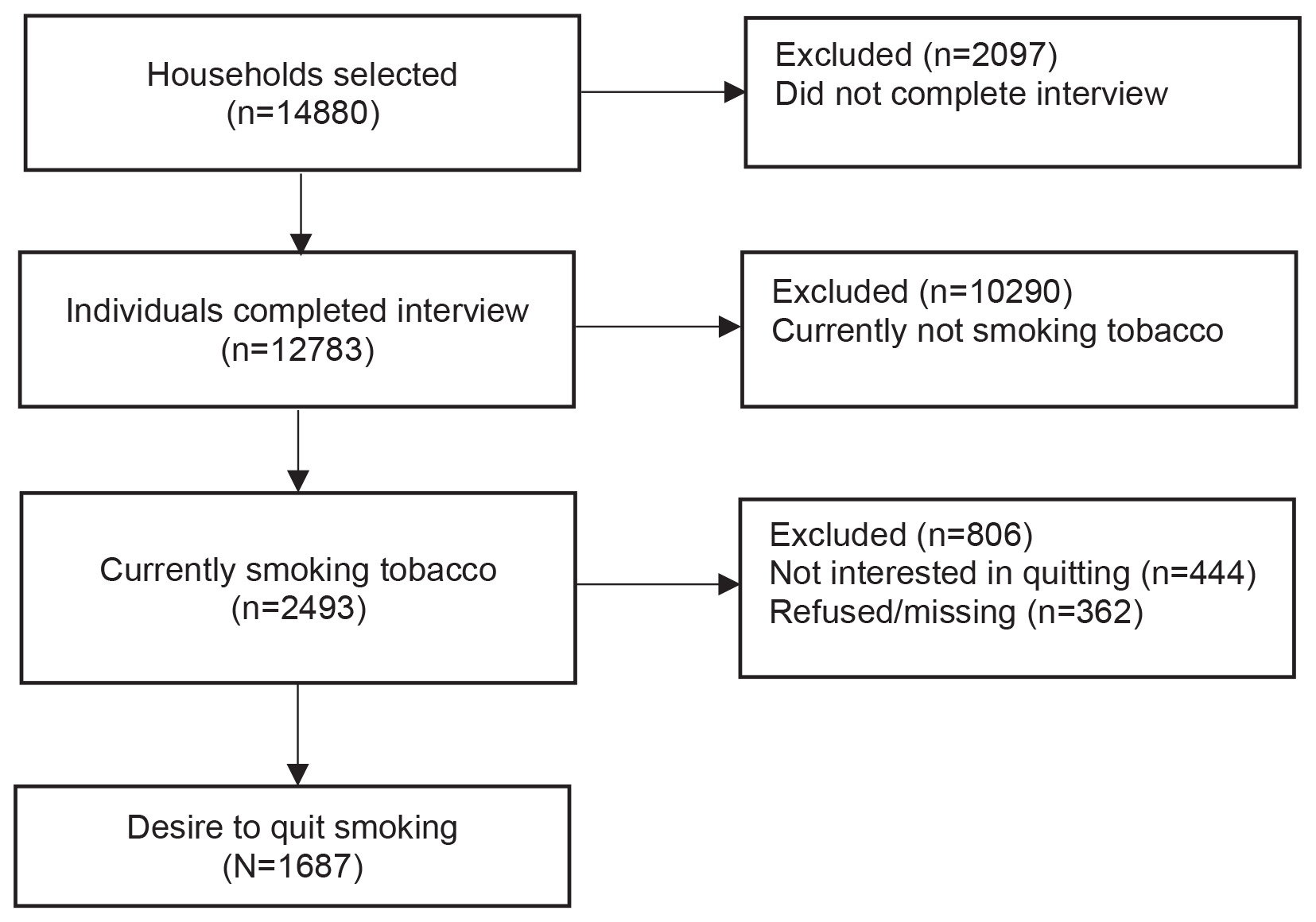
A multistage stratified cluster sampling design was used for the survey. In the first stage, 62 primary sampling units (PSUs) were selected from each of the eight administrative divisions, with an equal allocation of 31 PSUs from urban areas and 31 from rural areas, resulting in a total of 496 PSUs. In the second stage, 30 households were systematically selected from each PSU, yielding a total of 14880 households and a response rate of 96.8%. Households were randomly assigned as either male or female, ensuring an equal representation of both sexes. From each household, one eligible male or female was randomly selected. Ultimately, 12783 individuals aged ≥15 years completed the survey, achieving a response rate of 93.8%. This study focused on male and female adults who smoked tobacco products, including e-cigarettes, either daily or occasionally. Individuals who had never smoked tobacco products were excluded from the analysis.
Measures
Outcome variable
The primary outcome of the study was the desire to quit tobacco smoking, defined by participants’ self-reported intention to quit smoking in the future. This was assessed through the question: ‘Which of the following best describes your thinking about quitting smoking?’. Participants who chose one of ‘Quit within the next month’, ‘Thinking within the next 12 months’, or ‘Quit someday, but not next 12 months’ were categorized as having a ‘Desire to quit smoking’. Those who chose ‘Not interested in quitting’ were classified as ‘Do not have the desire to quit smoking’, a threshold used in another study16.
Potential factors
The study examined several independent variables, including sociodemographic factors such as age (15–24, 25–34, 35–44, or ≥45 years), sex (male or female), education (no formal education, middle school and lower, high school or equivalent degree, or college or higher), employment status (government, private, self-employed, unemployed or other), and residence (rural or urban). Additionally, the study also explored participants’ knowledge and attitudes toward tobacco control measures, including their views on tobacco taxes (negative or positive), family rules on smoking inside the home (not allowed or allowed). These variables were included in the multivariate logistic regression model to estimate adjusted associations with desire to quit smoking.
Statistical analysis
We examined the factors associated with the desire to quit smoking among adult smokers in Bangladesh. Before data coding, missing/refused responses were removed before and during analysis as part of the data cleaning process. To ensure nationally representative estimates, the complex survey design of the GATS was incorporated into all analyses by applying the sampling weights. Descriptive statistics were used to assess the distribution of smokers based on various characteristics. Pearson’s χ2 test was then performed to explore the relationship between the desire to quit smoking and the independent factors. Because the number of female smokers in the sample was too small to support stable regression estimates, the regression analysis was restricted to male smokers. To further investigate these relationships, logistic regression modeling was conducted to identify factors associated with the desire to quit smoking. Both bivariate and multivariate survey-weighted logistic regression models were employed using the svyglm function in the survey package in R version 4.6.0. The multivariate model was adjusted for age, education level, employment status, residence, attitude toward raising tobacco taxes, household smoking rules, and belief that cigarettes are addictive, with each variable controlling for all others in the model. The results are presented as crude odds ratios (ORs) and adjusted odds ratios (AORs) with 95% confidence intervals.
RESULTS
Distribution of sociodemographic characteristics and attitude of tobacco smokers
A total of 12783 individuals participated in and completed the GATS-Bangladesh questionnaire in 2017, as demonstrated in Table 1. Of the total sample, 2493 respondents (19.5%) were tobacco smokers who were included in this study. Among them, the majority were males (98%), with most being aged >45 years (37%). The majority of the respondents (38%) did not have formal schooling, and more than 50% were self-employed. Approximately 76% of respondents resided in rural areas, while only 24% resided in urban areas. Additionally, nearly 80% of the tobacco smokers had a positive attitude toward raising tobacco taxes, and 58% did not have strict rules against smoking inside their homes. Among tobacco smokers, 98% believed that tobacco causes serious illness, and 92% believed that cigarettes are addictive. The majority of the smokers (79%) were interested in quitting smoking.
Table1
Characteristics of adult tobacco smokers in Bangladesh, GATS 2017 (N=2493)
Table 2 presents the weighted distribution of desire to quit smoking among male current smokers according to sociodemographic characteristics and tobacco-related attitudes. Overall, desire to quit differed significantly only by place of residence, while education level showed a borderline association.
Table 2
Survey-weighted bivariate analysis of factors associated with the desire to quit smoking among adult tobacco smokers in Bangladesh, GATS 2017 (N=2096)
| Characteristics | No (N=421) na (%) | Yes (N=1675) na (%) | p* |
|---|---|---|---|
| Age (years) | 0.6 | ||
| 15–24 | 39 (25) | 134 (75) | |
| 25–34 | 106 (21) | 438 (79) | |
| 35–44 | 118 (20) | 470 (80) | |
| ≥45 | 158 (19) | 633 (81) | |
| Education level | 0.05 | ||
| No formal schooling | 154 (21) | 557 (79) | |
| Lower than primary school | 97 (22) | 353 (78) | |
| Primary school | 62 (25) | 186 (75) | |
| Lower than secondary school | 69 (21) | 318 (79) | |
| Secondary school | 13 (12) | 107 (88) | |
| College and higher | 26 (9.5) | 154 (90) | |
| Employment status | 0.7 | ||
| Employee (govt/non-govt) | 50 (17) | 217 (83) | |
| Business | 87 (20) | 408 (80) | |
| Self-employed | 232 (21) | 871 (79) | |
| Unemployed/other | 52 (21) | 179 (79) | |
| Residence | 0.04 | ||
| Rural | 245 (22) | 878 (78) | |
| Urban | 176 (16) | 797 (84) | |
| Raising tobacco taxes | >0.9 | ||
| Positive | 304 (21) | 1,233 (79) | |
| Negative | 96 (20) | 351 (80) | |
| Smoking inside the home | 0.10 | ||
| Not allowed | 46 (16) | 208 (84) | |
| Allowed | 96 (24) | 402 (76) | |
| Believe cigarettes are addictive | 380 (21) | 1541 (79) | 0.7 |
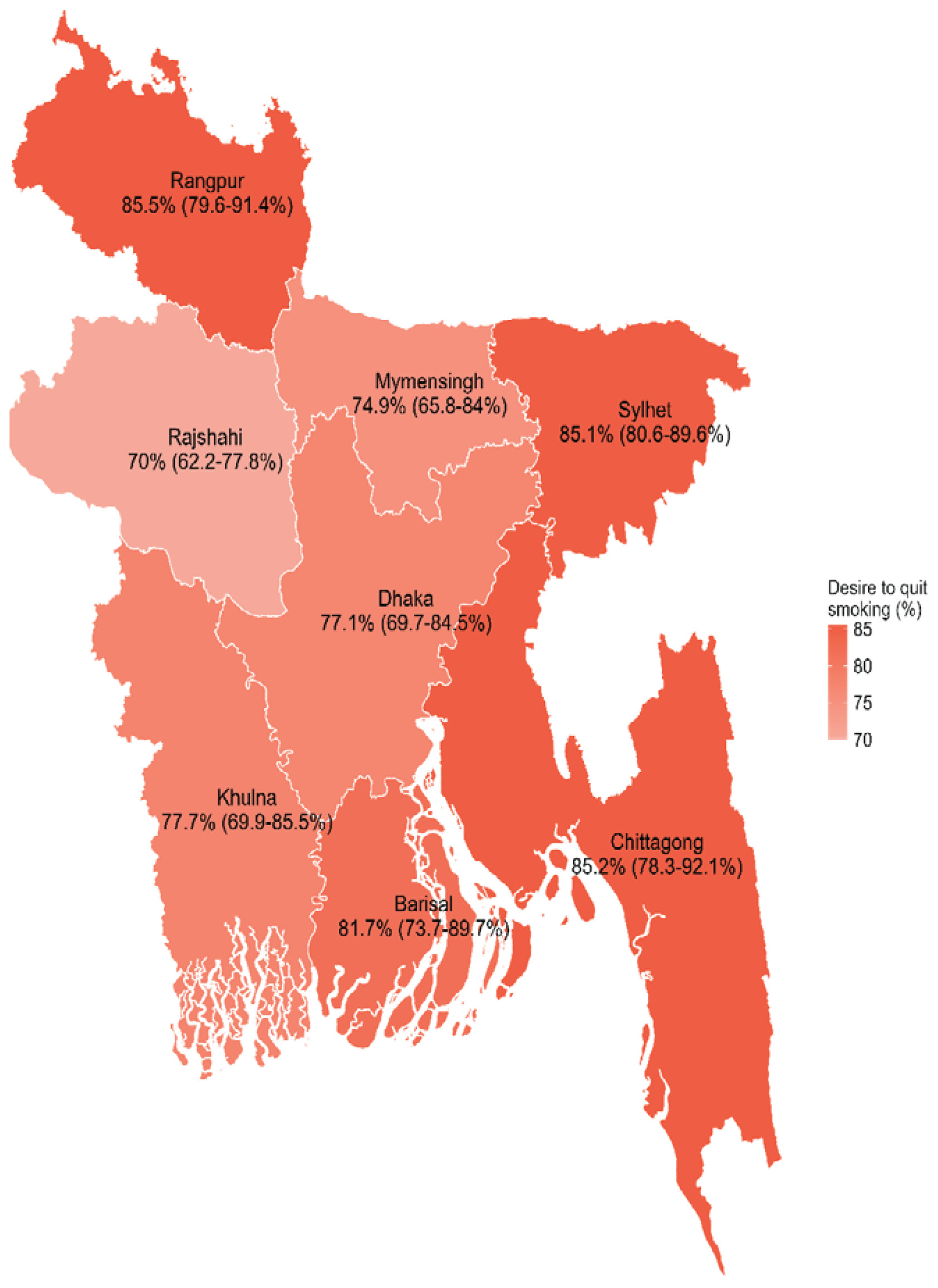
Urban smokers were significantly more likely to report a desire to quit than their rural counterparts (84% vs 78%; p=0.04). A graded pattern was observed across education level, with desire to quit rising from 75–79% among smokers with primary education or lower, to 88–90% among those who had completed secondary education or higher; however, this association did not reach conventional statistical significance (p=0.05). A similar borderline pattern was observed for household smoking rules, with a higher desire to quit among smokers who were not allowed to smoke inside the home compared to those who were (84% vs 76%; p=0.10). In contrast, desire to quit did not differ significantly by age group (p=0.6), employment status (p=0.7), support for raising tobacco taxes (p>0.9), or belief that cigarettes are addictive (p=0.7). Notably, desire to quit smoking ranged from 70.0% (95% CI: 62.2–77.8) in Rajshahi to 85.5% (95% CI: 79.6–91.4) in Rangpur, with similarly high proportions in Chittagong (85.2%) and Sylhet (85.1%) (Figure 2).
Factors influencing desire to quit smoking
In the univariable analysis, secondary education and higher was associated with greater odds of desiring to quit smoking compared to no formal schooling (OR=2.47; 95% CI: 1.12–5.47, p=0.025), and urban residence was associated with higher odds compared to rural residence (OR=1.49; 95% CI: 1.01–2.18, p=0.043). Secondary school education level showed a borderline association (OR=1.98; 95% CI: 0.97–4.03, p=0.05). No other variables were significantly associated with desire to quit smoking in the univariable models. After adjustment for all covariates in the multivariable model, none of the associations remained statistically significant, including education level and residence (all p>0.05), and confidence intervals were considerably wider across most estimates. Although not reaching significance, business ownership (AOR=0.48; 95% CI: 0.20–1.15, p=0.10) and unemployed/other status (AOR=0.26; 95% CI: 0.06–1.08, p = 0.064) showed a trend toward lower odds of desiring to quit relative to employed smokers, while secondary school completion showed a trend toward higher odds (AOR=3.22; 95% CI: 0.94–11.0, p=0.063) (Table 3).
Table 3
Survey-weighted binary logistic regression analysis of factors associated with the desire to quit tobacco smoking among adult tobacco smokers in Bangladesh: GATS, 2017
DISCUSSION
This study examines the desire to quit smoking among tobacco smokers in Bangladesh using nationally representative data from the 2017 GATS15. The findings revealed that the national prevalence of tobacco smoking was 19.5%, higher than the WHO report of 18.6% in 202017. The sociodemographic characteristics of the tobacco smokers were predominantly males, aged ≥45 years, with no formal education, and self-employed. Additionally, tobacco smokers largely supported raising tobacco taxes and believed that tobacco causes serious illness and is addictive. However, a significant number were allowed to smoke inside the home.
Consistent with findings from previous research, this study found that tobacco smokers were predominantly males and individuals with little or no formal education18,19. However, there were notable differences between this study and others. While this study found that tobacco smokers were mainly adults aged ≥45 years, other studies reported a higher percentage among smokers aged <40 years18,19. Additionally, this study was dominated by illiterate tobacco smokers, whereas other studies reported smokers with 1–8 years of schooling18,19. These differences could be attributed to different time periods and sampling strategies.
Among tobacco smokers, 79% expressed a desire to quit smoking, a higher percentage compared to previous studies18,19. Globally, the WHO reported that 60% of the 1.3 billion tobacco users have expressed a desire to quit20. The intention to quit smoking varies in neighboring and other middle-income countries, lower than in this study. For instance, the intention to quit smoking among current smokers was reported as 55.4% in India, 25% in Pakistan, 59.7% in Malaysia, 63.4% in Indonesia, 63.7% in the Philippines, 51.6% in Sri Lanka, 54.0% in Thailand, and 53.6% in Vietnam21-28. Furthermore, there was a significant association between smoking and receiving advice from a doctor to quit smoking18,29. In Bangladesh, 65.8% of tobacco smokers who visited a healthcare provider in the past 12 months were advised to quit smoking, compared to 48.8% in India, 50% in Pakistan, 66.6% in Malaysia, 38.9% in Indonesia, 54.5% in the Philippines, 47% in Sri Lanka, and 55.8% in Thailand21-28.
Factors associated with the intention to quit were consistent with other studies. Employment status and residence were significantly associated with the desire to quit smoking, though another study found these factors insignificant29. However, the study was not nationally representative. Although the study did not find an association between age and the desire to quit smoking, another study has reported that older adults were more successful in quitting smoking, likely due to experiencing more health problems29. Education level nearly reached significance with a greater interest in quitting smoking, as supported by another study30. This could be due to greater health literacy and access to cessation programs. Anti-smoking campaigns may be effective in promoting smoking cessation among smokers with lower levels of education31. Smokers living in urban areas were 1.5 times more interested in quitting smoking than those in rural areas, possibly due to a higher level of education and greater access to healthcare facilities and cessation programs. It aligns with an earlier nationally representative study reporting that rural smokers had lower odds of quitting compared to urban smokers and were less likely to use cessation aids32. Additionally, in contrast to a previous study linking support for tobacco taxation with greater interest in quitting, attitudes toward raising tobacco taxes showed no significant association with desire to quit in our study33. However, the Bangladesh government has pledged to meet tobacco-related objectives as part of its commitments under the Global Action Plan for the Prevention and Control of Non-Communicable Diseases (NCDs) and the Sustainable Development Goals (SDGs)34. Attitudes toward raising tobacco taxes play a crucial role in reaching these targets and achieving a tobacco-free Bangladesh by 204035. A previous study found that smokers living in a smoke-free home were more likely to make a quit attempt10. Smokers who reported allowing smoking inside their homes demonstrated less interest in quitting smoking, although this finding did not reach statistical significance. This could be because there are fewer social pressures or norms discouraging smokers from changing their behavior, potentially resulting in reduced motivation to quit smoking among residents36. Several factors – including age, employment status, attitudes toward raising tobacco taxes, home smoking rules, and beliefs about the addictiveness of cigarettes – were not significantly associated with desire to quit smoking in either the unadjusted or adjusted models, suggesting that desire to quit did not vary meaningfully across these subgroups.
Strengths and limitations
Our study identified several key factors associated with the desire to quit smoking and has notable strengths. First, we employed a nationally representative cross-sectional sample. Second, our statistical model met all necessary assumptions. However, there are limitations to consider. The study relied on self-reported household survey data, which may have introduced response bias due to social desirability or recall bias. Self-reported smoking behaviors and desire to quit may also have resulted in misclassification of participants’ smoking status or quitting intentions. Furthermore, the data were collected seven years ago, and tobacco control policies and smoking cessation initiatives in Bangladesh have evolved substantially since then, which may limit the current applicability of the findings. In addition, the cross-sectional design precludes establishing temporal or causal relationships between the identified factors and the desire to quit smoking. Finally, although we adjusted for a range of potential confounders, some variables were excluded because of multicollinearity concerns.
CONCLUSIONS
Among male tobacco smokers in Bangladesh, three in four expressed a desire to quit, higher than rates reported globally and in neighboring countries. Urban residence and education level showed the strongest associations with desire to quit, though neither remained significant after adjustment. These findings support continued investment in cessation programs and tobacco control policies, particularly targeting rural and less-educated smokers, to advance Bangladesh’s goal of a tobacco-free nation by 2040. Further research with adequate female representation is needed to assess sex-specific patterns.